

In telling the epic story of the Motunui Epa, historian Rachel Buchanan creates a taonga of her own
- Written by Jonathan Barrett, Associate Professor in Commercial Law and Taxation, Te Herenga Waka — Victoria University of Wellington
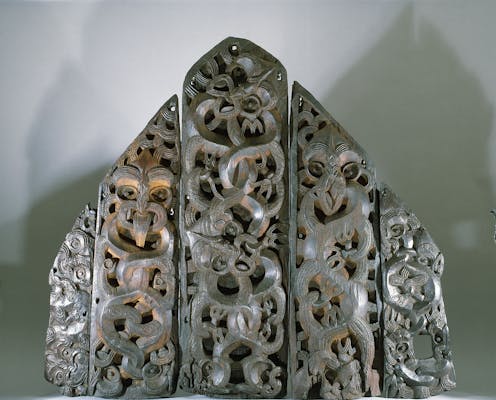
The celebrated art critic Ernst Gombrich identified Māori carving (whakairo) as a triumph of human culture. Unfortunately, beautiful artefacts often attract the attention of plunderers, unscrupulous dealers and complicit collectors.
Rachel Buchanan’s Te Motunui Epa tells the story of a set of exquisitely carved pātaka (storehouse) panels that were illegally removed from the country in the early 1970s and acquired by a Swiss-based collector. The panels were eventually repatriated, at great cost to the government, and restored to Taranaki in 2014.
Review: Te Motunui Epa – Rachel Buchanan (Bridget Williams Books)
Like many such stories, the facts are convoluted and novelistic. But unlike the research of other New Zealand art crime experts, notably Penelope Jackson and Arthur Tompkins, for Buchanan (Taranaki, Te Ātiawa) the illegal removal of the Motunui panels is both personal and communal.
In a European worldview, we generally believe artists have a special psychological connection to the works they create. So-called moral rights under copyright law give some legal effect to that belief. Also, when an identifiable person is the subject of an artwork, their descendants may hold strong emotional links to that image.
This sentiment partly explains the doggedness with which descendants of Jewish collectors, whose artworks were confiscated during the Nazi era, pursue restitution. But I don’t think we can fully understand the importance of particular taonga (treasure) for their hapū and iwi.
Read more: Imperial loot in a small-town gallery in New Zealand? The curious case of Gore’s ‘Benin bronzes’
Nevertheless, when Buchanan explores the meaning of utu, the non-Māori reader may gain some understanding of the importance of repatriation. Utu has many meanings, depending on context. Buchanan tells us: “Utu is about relationships [… it] is a return or payback, reciprocity, a satisfaction, a ransom, a reward, a price, a reply, evening things up”. When taonga have been taken from a community, only return can restore utu as harmony.
The broad story of the panels is generally well known. Finlayson, for example, presented an insider narrative at the first Art Crime Symposium in Wellington in 2015. But Buchanan delves deep into numerous archives, Hansard, Official Information Act requests, and even interviewed the unrepentant dealer who spirited the panels out of the country.
The government’s attempts to reclaim the panels started in the Muldoon era. Buchanan identifies and gives credit to the numerous actors in the public service, the galleries, libraries, archives, and museums sector, the law and academia who contributed over many years to repatriation.
Read more: 'Restitution' of looted African art just continues colonial policies - much more is at stake
Tūpuna and taonga
Whereas carving involves the removal of material to create, Buchanan is a skilful weaver who draws different strands – the narrative, legal arguments, politics, human emotions, te ao Māori – into a cohesive whole.
Buchanan’s writing is unashamedly poetic and spiritual. That does not detract from the rigour of her research but might distance a reader who likes their history plain, factual and passionless. Her anthropomorphising of the panels makes sense – they are tūpuna (ancestors) – but that approach can lead to overwrought language.
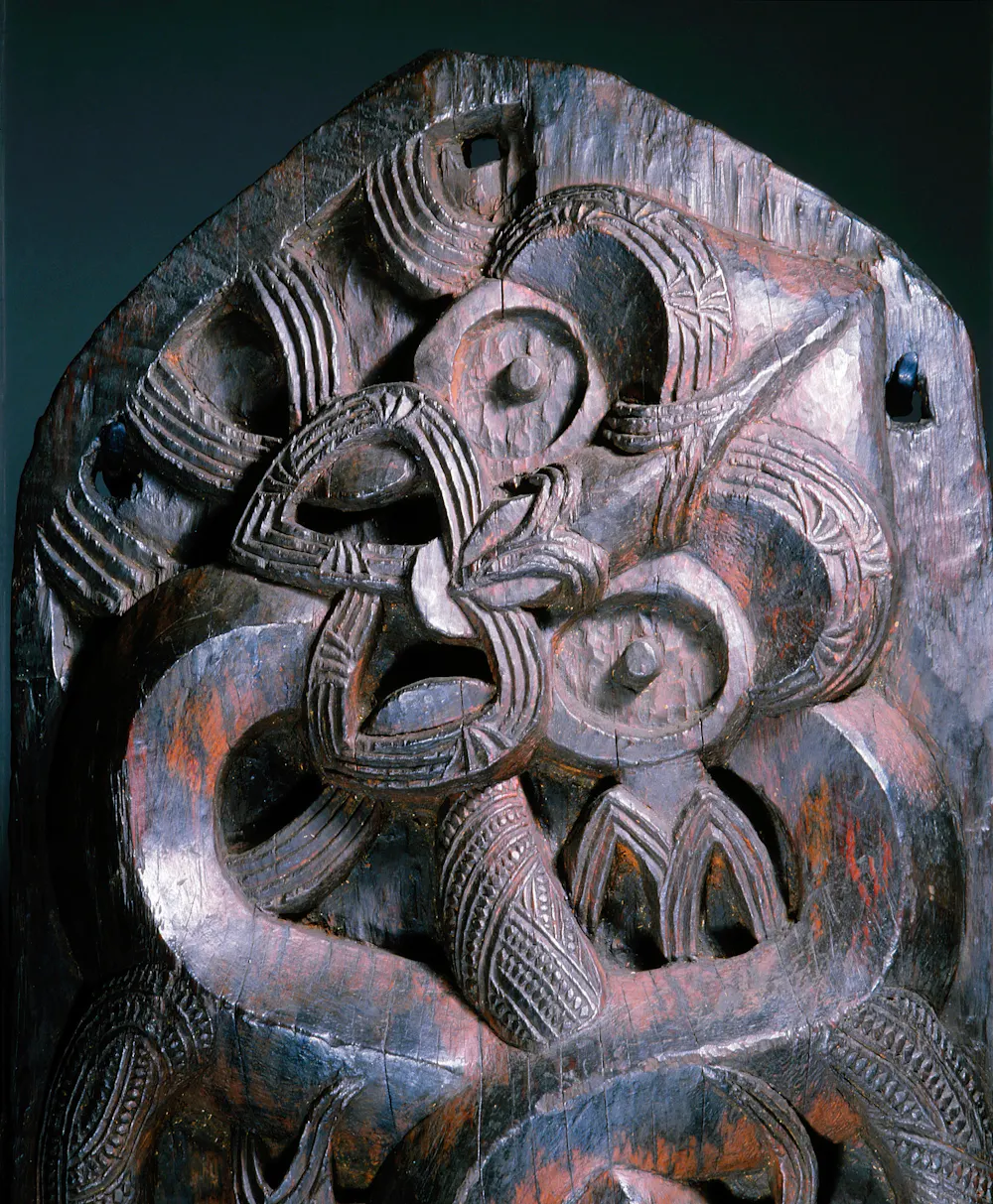 Detail of the central panel.
Werner Forman/Getty Images
Detail of the central panel.
Werner Forman/Getty Images
For example, “In that dark place, our tūpuna began to write their thoughts on the underside of the coffin lids” smacks of improbable magical realism. There is some unnecessary repetition of facts, and the eminent lawyer (later judge) Sir Ted Thomas is referred to as Edward rather than Edmund.
But these are petty quibbles. A more important concern is the lack of an index. Publishers today may be unwilling to pay for professional indexers, but this is a sumptuous book with liberal illustrations, not a budget paperback.
Like Gombrich, I’m awed by Māori whakairo. But as an outsider, I can’t fully appreciate what it means to the communities from which taonga emerge and where they belong. For Pākehā, this book represents a generous sharing of insights into te ao Māori, in particular the world of the Indigenous people of Taranaki.
For those most familiar with Bridget Williams Books’ Text paperbacks, this book will come as a revelation. It’s beautifully designed and realised. Judge this book by its lovely cover. In her account of a lost and retrieved treasure, Buchanan has herself created a taonga.
Authors: Jonathan Barrett, Associate Professor in Commercial Law and Taxation, Te Herenga Waka — Victoria University of Wellington


 Hashtag.net.au
