

the pop culture robots that influenced smart voice assistants
- Written by Justine Humphry, Lecturer in Digital Cultures, University of Sydney
Last year, nearly one third of Australian adults owned a smart speaker device allowing them to call on “Alexa” or “Siri”. Now, with more time spent indoors due to COVID-19, smart voice assistants may be playing even bigger roles in people’s lives.
But not everyone embraces them. In our paper published in New Media Society, we trace anxiety about smart assistants to a long history of threatening robot voices and narratives in Hollywood.
The warm and solicitous female voices of smart assistants contrast with cinematic robot archetypes of the “menacing male” or “monstrous mother”, with their highly synthesised voices and dangerous surveillant personalities.
Instead, smart assistants voices have been strategically adapted by companies like Google, Apple and Amazon to sound helpful and sympathetic.
‘Menacing males’ and ‘monstrous mothers’
In the early 20th century, robots were marvels of futuristic technology. The first voice given to a robot was Bell Labs’ “the Voder” in 1938. This was a complex device (typically played by Bell’s female telephone operators) that could generate slow and deliberate speech, composed of various manipulations of generated waveforms.
While they appeared in earlier movies, in the 1950s robots truly came into their own on screen.
With distinctive sounds that gave the robots a sense of otherness, they became associated with narratives of science gone out of control, such as in Forbidden Planet (1956) and The Collossus of New York (1958). HAL 9000, the infamous computer in Stanley Kubrick’s 2001 A Space Odyssey (1968), becomes murderous as the computer shows its allegiance to the mission at the cost of the crew.
Later, film makers started exploring robots as maternal figures with misplaced instincts.
In the Disney movie Smart House (1999), the home turns into a controlling mother who flies into a rage when the family refuses to cede to her demands. In I, Robot (2004), the computer VIKI and her robot hordes turn against people to protect humanity from itself.
But perhaps the most enduring vision of robots is neither a menacing male nor a monstrous mother. It is something more human, as in Bladerunner (1982), where the replicants are hard to distinguish from humans. These humanoid robots continue to predominate on the small and big screen, showing increasingly more psychologically complex characteristics.
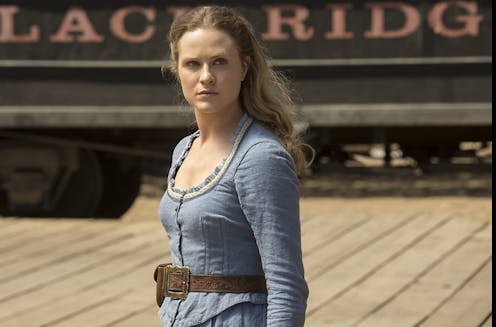
As the robots Maeve and Dolores achieve more sentience in the Westworld TV series (2016), their behaviour becomes more natural, and their voices become more inflected, cynical and self-aware. In Humans (2015), two groups of anthropomorphic robots, called “synths”, are distinguished by one group’s ability to more closely resemble humans through features of natural conversation, with more animation and meaningful pauses.
From fiction to reality
In these films the voice is a crucial vehicle with which robots express a persona. Smart assistant developers adopted this concept of developing persona through voice after recognising the value in getting consumers to identify with their products
Apple’s Siri (2010), Microsoft’s Cortana (2014), Amazon’s Echo (2015) and Google Assistant (2016) were all introduced with female voice actors. Big tech companies strategically selected these female voices to create positive associations. They were the antithesis of the menacing male or monstrous mother cinematic robot archetypes.
But while these friendly voices could steer consumers away from thinking of smart assistants as dangerous surveillant machines, the use of female-by-default voices has been criticised.
Smart assistants have been described as “wife replacements” and “domestic servants. Even UNESCO has warned smart assistants risk entrenching gender bias.
Read more: There's a reason Siri, Alexa and AI are imagined as female – sexism
Perhaps it is for this reason the newest smart-voice is the BBC’s Beeb, with a male northern English accent. Its designers say this accent makes their robot more human-like. It also echoes traditional media practices using the masculine voice of authority.
Of course, it’s not all in the voice. Smart assistants are programmed to be culturally competent in their relevant market: the Australian version of Google Assistant knows about pavlova and galahs, and uses Australian slang expressions.
Gentle humour, too, plays a significant role in humanising the artificial intelligence behind these devices. When asked, "Alexa, are you dangerous?”, she replies calmly, “No, I am not dangerous.”
Smart assistants resemble the humanoid robots in latter-day pop culture – sometimes nearly indistinguishable from humans themselves.
Dangerous intimacy
With voices that are apparently natural, transparent and depoliticised, the assistants give only one brief answer to each question and draw these responses from a small range of sources. This gives the tech companies significant “soft power” in their potential to influence consumers’ feelings, thoughts and behaviour.
Smart assistants may soon play an even more intrusive role in our everyday affairs. Google’s experimental technology Duplex, for instance, allows users to ask the assistant to make phone calls on their behalf to perform tasks such as booking a hair appointment.
Read more: AI can book a restaurant or a hair appointment, but don't expect a full conversation
If it/she can pass as “human”, this might further risk manipulating consumers and obscuring the implications of surveillance, soft power and global monopoly.
By positioning smart assistants as innocuous through their voice characteristics – far from the menacing males and monstrous mothers of the cinema screen – consumers can be lulled into a false sense of security.
Authors: Justine Humphry, Lecturer in Digital Cultures, University of Sydney

 Hashtag.net.au
