

As Morrison and Ardern meet, differences of opinion give way to the enduring close relationship
- Written by Mark Kenny, Professor, Australian Studies Institute, Australian National University
Scott Morrison can feel well satisfied after travelling to New Zealand for the final two days of May. Talks there with his prime ministerial counterpart, Jacinda Ardern, could have been uneasy. Instead, the warmth of the face-to-face meeting – a rarity in these pandemic times – underscored the geographic and cultural closesness of the two nations, the primacy of the bilateral relationship above individual irritants, and their uncommon success in keeping COVID under control.
As late as last week, before the current Melbourne lockdown, the two nations could lay claim to have functionally eliminated the virus. Both have had virtually zero community transmission in recent months.
For Morrison, the bilateral visit marked the first, and potentially simplest, of a series of international meetings this year, if only because of the exclusive travel bubble between the two ANZUS partners.
G7 talks in Britain later in June and a high-profile, high-expectation UN climate conference in Glasgow in November present Australia’s climate-intransigent PM with far pricklier problems.
Pressure is mounting on Morrison to demonstrate material progress on emissions abatement, rather than a mere continuation of Australian special pleading and the usual raft of glib slogans such as “technology not taxes”.
But, for all the apparent closeness of the trans-Tasman relationship, some frictions inevitably framed the lead-up to the talks. China, with its growing influence and insensitivity to regional concerns, was principal among these.
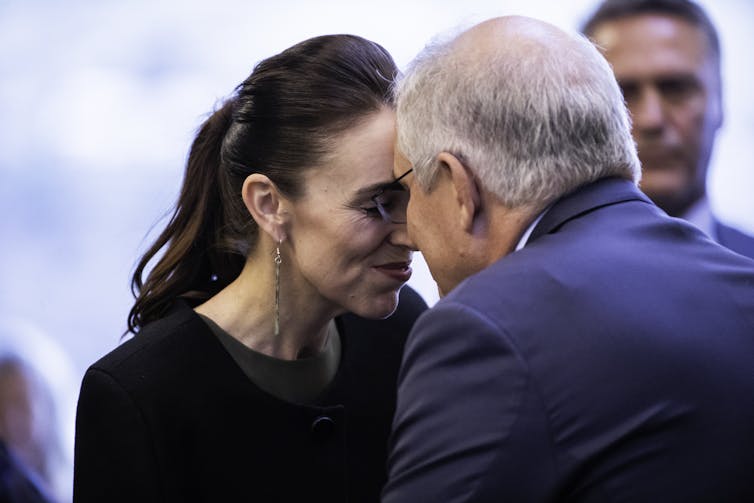 Whatever differences the two countries may have on some issues, these were kept well out of the spotlight.
Robert Kitchin/AAP
Whatever differences the two countries may have on some issues, these were kept well out of the spotlight.
Robert Kitchin/AAP
The Australian government has been privately nonplussed that Wellington had been seen to adopt a more conciliatory tone towards Beijing, despite the latter’s aggressive trade penalties on Australia. This particularly pertains to barley, where claims of Australian dumping have seen punitive 80% tariffs applied.
In April, NZ Foreign Minister Nanaia Mahuta signalled New Zealand’s preference for restricting the Five Eyes alliance to its original remit of intelligence sharing between the US, Britain, Canada, Australia and New Zealand.
Read more: Twin challenges of China and trans-Tasman migration loom over Scott Morrison's New Zealand visit
Her comments came just weeks after a first-ever leaders’ level virtual meeting of the Quadrilateral Security Dialogue (“Quad”), made up of the US, Japan, Australia and India. It was one of several examples where Ardern’s Labour government has given vent to that country’s historically more non-aligned tendencies.
Beijing viewed the Quad meeting as a provocative escalation of a US-led and Australian-supported China containment strategy.
Mahuta’s comments – which tended to overshadow a speech more specifically critical of Beijing – were read in this light: evidence of a widening gap between the approaches to Beijing by the trans-Tasman countries.
New Zealand Trade Minister Damien O'Connor had previously gone as far as to chide Australia for a lack of sophistication in its dealings with Beijing. While announcing an upgraded free trade agreement, he said:
If [Australia] were to follow us and show respect, I guess a little more diplomacy from time to time and be cautious with wording, they too could hopefully be in a similar situation [with China].
But, in clear statement of support, New Zealand announced shortly before the talks that it would back Australia’s case on barley tariffs before the World Trade Organisation.
Paragraph 37 of the joint communique was the official, if somewhat Delphic, expression of this:
The Prime Ministers affirmed their strong support for open rules-based trade that is based on market principles. They expressed concern over harmful economic coercion and agreed to work with partners to tackle security and economic challenges.
There were also clearly stated objections to human rights abuses in Hong Kong and Xinjiang, concerns over China’s actions in the South China Sea, and a pledge to “uphold sovereignty” in the Indo-Pacific.
The two leaders also committed to jointly work to counter foreign interference in “education, infrastructure, research, electoral processes, media, and communities”.
The other main matter of trans-Tasman friction derives from Australia’s practice of deporting New Zealand-born long-term Australian residents when they are convicted of a serious crime. This happens irrespective of whether they have any association or family ties to New Zealand.
Ardern has made no secret of her disappointment with Australian intransigence on the issue and has vowed to continue pressing it. Yet, speaking to TVNZ, there was a tone of resignation also in her words, as if she knew the smaller country would not get the larger one to cede ground.
I’ve raised this through the entire time that I’ve been in this role and not necessarily with an expectation that we’ll see a dramatic change in policy because Australia has been consistent in the fact that they don’t intend to change their policy on things like deportation […] so it’s something that I’ll continue to raise".
But if these matters presented risk to the talks, their management appears to have been deftly handled in the broader interests of the relationship.
China’s response to New Zealand will be interesting, in the unlikely event that it expresses one.
Authors: Mark Kenny, Professor, Australian Studies Institute, Australian National University


 Hashtag.net.au
