

Forget work-life balance – it's all about integration in the age of COVID-19
- Written by Melissa A. Wheeler, Senior lecturer, Swinburne University of Technology
It wasn’t the usual end to our staff meeting.
This time, the head of our university department wrapped up the video conference by inviting her nine-year-old son to come and say hello to about a hundred colleagues.
It was an acknowledgement of the changes we have all adopted due to the COVID-19 pandemic. The responses required to contain the spread of the virus have obliterated the boundaries that conventionally separate work from the rest of our lives. It has left us questioning the old concept of work-life balance.
Read more: 6 strategies to juggle work and young kids at home: it's about flexibility and boundaries
The myth of balance
The idea of work-life balance caught on the 1980s, powered to a large extent by the increasing number of women in the paid workforce who also shouldered the bulk of home and family work.
While it is a concept somewhat hard to define and based on many assumptions, definitions of work-life balance tend to focus on the “absence of conflict” between professional and personal domains.
Read more: The more work-life balance we have the more we want: global study
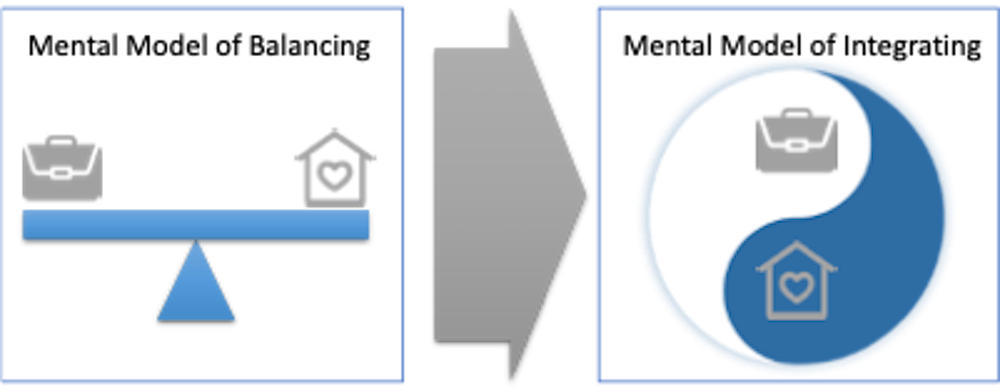
The intention is noble. The problem, in the words of business scholar Stewart Friedman, is that “balance is bunk”:
It’s a misguided metaphor because it assumes we must always make trade-offs among the four main aspects of our lives: work or school, home or family (however you define that), community (friends, neighbours, religious or social groups), and self (mind, body, spirit).
Friedman, a professor at the prestigious Wharton School of the University of Pennsylvania, founded the Wharton Work/Life Integration Project in 1991 to “produce knowledge for action on the relationship between work and the rest of life”.
A more realistic and more gratifying goal than balance, he argues, is to better integrate work and the rest of life in ways that engender “four-way wins” between work, home, community and self.
 Asanka Gunasekara, Author provided
Synergies, not trade-offs
Integration is not about trade-offs but synergies, gaining more by combining aspects of life often deliberately quarantined from each other.
Psychologists Jeffery Greenhaus and Saroj Parasuraman describe integration as “when attitudes in one role positively spill over into another role, or when experiences in one role serve as resources that enrich another role in one’s life”.
A pre-COVID-19 example might be participating in a work-sponsored fun run for charity. It’s as chance to deepen your bonds with colleagues and do something good for the community. And exercise is good for both your physical and mental health.
Making integration the new normal
What would work-life integration look like in the age of COVID-19?
Perhaps it is a father who invites his children and partner to discuss a workplace challenge he is facing over dinner.
Working from home has been particularly onerous for families with kids cooped up and parents having to take on homeschooling duties. In this scenario, talking through a workplace issues enables the family to support each other and to feel a part of each other’s lives.
In the case of our departmental head introducing her son at the end of the video conference, it reminded the rest of us about the demands of working at home at this time.
Her son, meanwhile, got a chance to better appreciate his mother’s work, with nearly a hundred little boxes of faces no doubt helping him to understand why she is not always available. It was an opportunity to increase empathy and understanding from both colleagues and family. It sent a positive message that all employees are entitled to this understanding.
Integration also allows us the opportunity to throw away the idea of being the “perfect” partner or parent and instead work on being more open, honest, and even vulnerable.
But first we need to recognise that COVID-19 has dramatically changed personal and work dynamics, and we need to let go the mental model of thinking of work-time and home-time being distinct and separate blocks.
Asanka Gunasekara, Author provided
Synergies, not trade-offs
Integration is not about trade-offs but synergies, gaining more by combining aspects of life often deliberately quarantined from each other.
Psychologists Jeffery Greenhaus and Saroj Parasuraman describe integration as “when attitudes in one role positively spill over into another role, or when experiences in one role serve as resources that enrich another role in one’s life”.
A pre-COVID-19 example might be participating in a work-sponsored fun run for charity. It’s as chance to deepen your bonds with colleagues and do something good for the community. And exercise is good for both your physical and mental health.
Making integration the new normal
What would work-life integration look like in the age of COVID-19?
Perhaps it is a father who invites his children and partner to discuss a workplace challenge he is facing over dinner.
Working from home has been particularly onerous for families with kids cooped up and parents having to take on homeschooling duties. In this scenario, talking through a workplace issues enables the family to support each other and to feel a part of each other’s lives.
In the case of our departmental head introducing her son at the end of the video conference, it reminded the rest of us about the demands of working at home at this time.
Her son, meanwhile, got a chance to better appreciate his mother’s work, with nearly a hundred little boxes of faces no doubt helping him to understand why she is not always available. It was an opportunity to increase empathy and understanding from both colleagues and family. It sent a positive message that all employees are entitled to this understanding.
Integration also allows us the opportunity to throw away the idea of being the “perfect” partner or parent and instead work on being more open, honest, and even vulnerable.
But first we need to recognise that COVID-19 has dramatically changed personal and work dynamics, and we need to let go the mental model of thinking of work-time and home-time being distinct and separate blocks.
Authors: Melissa A. Wheeler, Senior lecturer, Swinburne University of Technology

 Hashtag.net.au
