

‘America First’ trade policy is pushing economic self-sufficiency – but history shows this is harder than it seems
- Written by Garritt C. Van Dyk, Senior Lecturer in History, University of Waikato
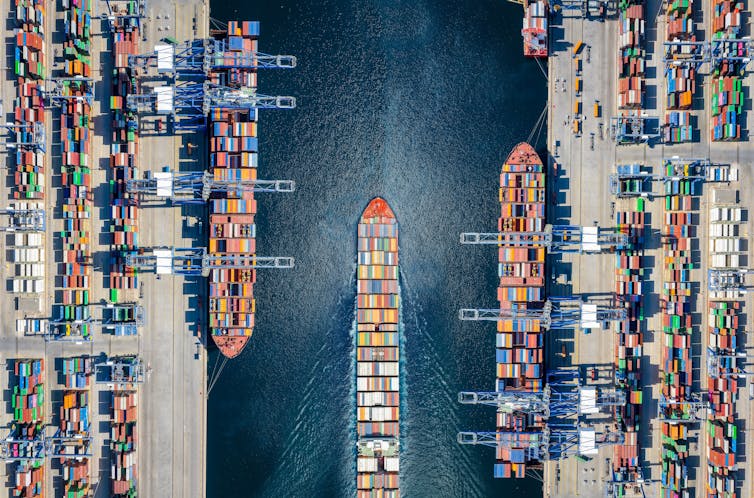
The day he took office for his second term, United States President Donald J. Trump unveiled his “America First” trade policy, including tariffs on imported goods from Mexico, Canada (both of which have since been paused) and China.
President Trump’s reasoning for the tariffs included revitalising the American economy by bringing manufacturing and business back within US borders. Essentially, pushing the country towards greater self-sufficiency.
Considering the cost of the tariffs, a number of countries have begun to question their dependence on foreign trade. But there are very clear hurdles including access to precious metals and raw materials.
In a global market that relies on international trade, is it possible to be totally self-sufficient?
The history of self-seficiency
The economic term for self-sufficiency is “autarky”, borrowed from the ancient Greek word autarkeia, meaning “to suffice”. Ideally, this meant that a state could supply the needs of its people without foreign trade. Autarky, in its purest form, isolates the state from foreign economic, political and cultural influence.
There are numerous historical examples of attempts to achieve complete economic autonomy.
In 17th century Japan the Tokugawa Shogunate closed the borders to foreigners and prohibited Japanese from travelling abroad.
There was limited private trade with China through Nagasaki and with Europe through Dutch merchants. They were confined to an artificial island, Deshima, off Nagasaki, to ensure their isolation. These restrictions remained for 265 years, until the threat of US gunboats forced Japan to sign a trade treaty in 1854.
Self-sufficiency was also a goal of Benito Mussolini’s fascist dictatorship, aiming to lift Italy’s post-war economy in the 1920s. One initiative was the “Battle for Wheat”, an attempt to produce enough wheat to meet domestic demand and “free the Italian people from the slavery of foreign bread”.
Italy imported more than one third of the flour needed to make bread and pasta, the two main foodstuffs. Pasta was targeted as a “backwards” food to promote consumption of local rice and reduce agricultural imports.
Tariffs were levied on all imported goods in 1931. These were raised again in 1935 after sanctions were imposed on Italy following the invasion of Ethiopia. Mussolini declared in 1935 that Italy “would manage alone”.
While imports of food, machinery and raw materials dropped, oil imports increased. Mussolini recognised the limits of autarky in 1934:
Let us not delude ourselves about autarky. All the modern nations, thanks to the prodigious development of the sciences, can move towards a partial autarky. But we, until the contrary is proven, will have to import liquid combustibles.
A modern push to self-sufficiency
Even with reduced reliance on fossil fuels, the scarcity of some natural resources, such as rare earth minerals, still poses a challenge to achieving autarky.
Even the Democratic People’s Republic of Korea (North Korea), a centrally planned economy subject to United Nations Security Council sanctions for its nuclear and ballistic missile testing since 2006, is not completely self-sufficient.
China is North Korea’s largest trading partner, with plastics, tobacco, soybean oil, rubber tires and packaged medicines as the top imports. The economic isolation of North Korea also makes it more vulnerable to global price fluctuations, as the movements are magnified due to the limited number of trading partners.
Supply chain disruptions were highlighted during the pandemic, continued in 2021 with shortages in microchips, followed by Russia’s war in Ukraine.
Some nations, such as the US and the United Kingdom, have responded to this logistical risk by shifting to local production, or reshoring, of certain critical industries, such as semiconductors and pharmaceuticals.
This inward turn requires significant investment and lead time and may involve higher local energy and labour costs, or additional environmental restrictions. For industries that involve national security or essential goods, reducing dependence on potential adversaries may be necessary. But for other sectors the higher costs will create inflationary pressure.
There are also implicit costs in cutting economic ties with the outside world. Foreign investment is reduced and innovation lags as there are fewer incentives for the cross-border flow of ideas.
Embracing friendshoring
As the push for self-reliance increases, vulnerable countries will need new strategies to remain resilient.
Identifying alternative supply chain relationships and increasing inventory stockpiles in advance will minimise disruptions.
Another tactic is “friendshoring” – relocating supply chains to countries where the risk of disruption from political chaos is low.
It is likely that geopolitical instability will increase and global fragmentation will continue. While straightforward autarky may not be possible, countries will need to consider how to survive the political and economic volatility of the next four years – and beyond.
Authors: Garritt C. Van Dyk, Senior Lecturer in History, University of Waikato


 Hashtag.net.au
