

Tunisia's struggling economy puts democracy at risk, Democracy News Alliance study finds
TUNIS, TUNISIA & LOS ANGELES, UNITED STATES - Newsaktuell - 30 September 2024 - DNA - Tunisia's political landscape is undergoing a perilous shift. Once celebrated as the Arab Spring's democratic success story, the country now faces the grim possibility of sliding back into authoritarianism, a new study warns.
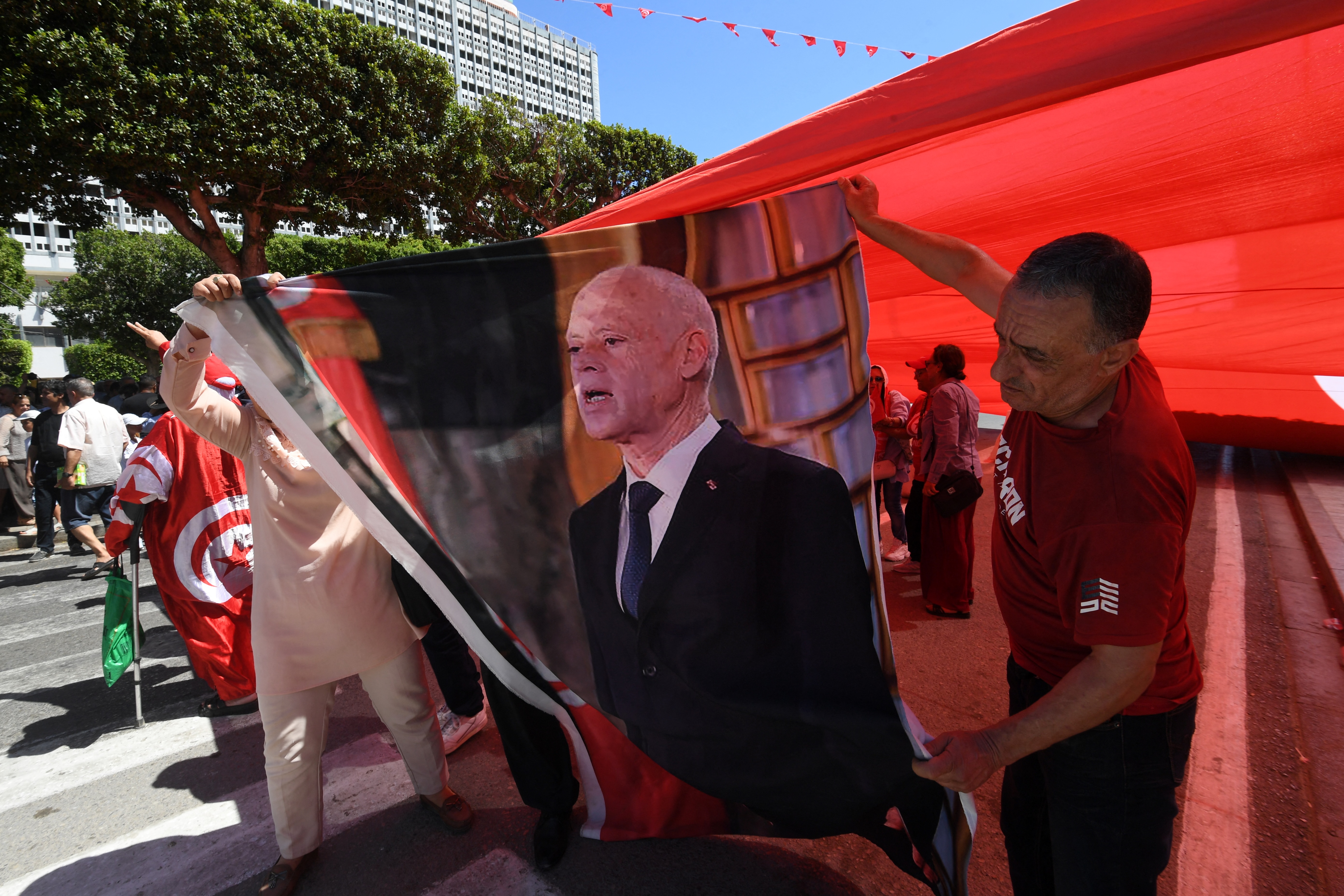
Backing for the President: Supporters of Tunisian President Kais Saied hold his image during a rally in Tunis, on July 25, 2024, as the nation celebrates the 67th anniversary of foundation of the republic. (Photo by Fethi Belaid / AFP)
As the October 2024 elections loom, analysts warn that President Kaïs Saïed may tighten his grip on power, threatening to reverse the hard-won gains from the 2011 Jasmine Revolution.
But what has led Tunisia to this moment? And why has economic stagnation stifled its democratic aspirations? Researchers behind a new Berggruen Governance Index (BGI) report analyze what happened and what may happen next.
In late 2010, mass protests erupted in Tunisia, setting the stage for the Jasmine Revolution. This movement, ignited by public outcry against the autocratic rule of Zine El Abidine Ben Ali, became the spark for the wider Arab Spring that swept through North Africa and the Middle East. While many neighboring nations soon experienced civil war or counter-revolution, Tunisia emerged as a beacon of hope.
The early years of Tunisia's post-revolution period were marked by a wave of political reforms. The newly formed democracy scored well on the BGI Democratic Accountability Index, and state capacity saw significant improvement as the country tried to rid itself of the corruption and inefficiencies of the past. By 2021, Tunisia had solidified its place as one of the few democracies in the region. Yet, beneath the surface, economic challenges persisted, laying the groundwork for a brewing crisis.
Despite the political gains, Tunisia's economic struggles were not resolved after the revolution. From 2010 onward, while democracy flourished, the provision of public goods such as education, health, and infrastructure remained lackluster. Economic growth stagnated, as highlighted by Tunisia's disappointing GDP per capita trends and the troubling rise in unemployment and poverty. Emigration grew steadily.
The Berggruen Governance Index report paints a clear picture of this dynamic. While Tunisia's democratic accountability score soared after 2011, its fiscal capacity faltered, dropping to concerning lows by 2021. Political stability did not translate into economic prosperity, and the failure to provide material benefits to the population eroded faith in democratic institutions. Disillusionment spread as citizens faced the same hardships under a new political system.
According to the report, which was conducted by researchers from the Luskin School of Public Affairs at the University of California Los Angeles (UCLA), the Los Angeles-based Berggruen Institute and the Hertie School, a university in Berlin, Germany, the economic stagnation is rooted in both internal and external factors. Internally, Tunisia's governance struggled to stabilize a post-revolution economy. Externally, a decline in foreign direct investment (FDI) exacerbated the situation, as investors grew wary of Tunisia's fragile political environment. The report based on the BGI shows that FDI, which had peaked at nearly 9.5 per cent of GDP under Ben Ali, plummeted after the revolution, contributing to Tunisia's deteriorating economy.
Current president Kaïs Saïed, a law professor who rose to prominence on a populist wave, secured victory in the 2019 elections. His election signaled a shift in Tunisia's political trajectory. While initially celebrated for challenging the elite, Saïed soon began to erode the very democratic foundations that had lifted him to power.
In 2021, Saïed suspended the parliament in what many labeled an "auto-coup." A year later, a constitutional referendum further expanded his powers at the expense of the legislative branch, fueling fears of a return to authoritarianism. Human rights organizations have raised alarms about his increasing use of repression, imprisonment of opposition leaders, and violent crackdowns on migrants. According to the study, Tunisia's democracy, once lauded, is now on the edge.
The political repression under Saïed's rule is setting the tone for the upcoming 2024 elections, which analysts predict will be a mere formality to legitimize his continued grip on power. According to reports from Human Rights Watch, opposition groups face severe restrictions, and one candidate is even running his campaign from prison.
The growing repression is particularly alarming as Tunisia grapples with a deepening economic crisis. The government's rejection of a 2 billion US-Dollar International Monetary Fund loan in 2023, criticized by President Saïed as a "dictate," was widely seen as a populist move. However, the rejection further isolated Tunisia from vital international financial support, leaving it struggling to address its economic problems. As citizens endure rising unemployment, inflation, and food insecurity, the prospects for a democratic recovery seem dim.
The situation in Tunisia offers a stark lesson about the relationship between democracy and economic development. According to the Berggruen Governance Index, countries with stronger democracies often enjoy higher standards of living. Yet, in Tunisia's case, democracy has failed to deliver the expected economic dividends. This failure is partly due to the inherent difficulties faced by developing democracies, where public pressure for immediate consumption can hinder long-term investments needed for sustainable growth. Furthermore, economic uncertainty in Tunisia has deterred foreign investors.
The precarious state of Tunisia's economy has had direct consequences for its citizens. Vulnerable employment is rising, and the share of undernourished individuals has climbed back to levels not seen since the revolution. The economic crisis has fueled social discontent, and with no clear solutions in sight, the country risks further instability.
The situation in Tunisia illustrates a broader challenge facing emerging democracies worldwide: the need to deliver both political reform and economic progress, the researchers write in their report. When governments fail to improve living standards, citizens may grow disillusioned with democracy, creating an opening for authoritarian leaders to consolidate power.
Further coverage by the Democracy News Alliance can be found in the DNA digital newsroom at https://www.presseportal.de/en/nr/174021
This text and the accompanying material (photos and graphics) is an offer from the Democracy News Alliance, a close co-operation between Agence France-Presse (AFP, France), Agenzia Nazionale Stampa Associata (ANSA, Italy), The Canadian Press (CP, Canada), Deutsche Presse-Agentur (dpa, Germany) and PA Media (PA, UK). All recipients can use this material without the need for a separate subscription agreement with one or more of the participating agencies. This includes the recipient's right to publish the material in own products.
The DNA content is an independent journalistic service that operates separately from the other services of the participating agencies. It is produced by editorial units that are not involved in the production of the agencies' main news services. Nevertheless, the editorial standards of the agencies and their assurance of completely independent, impartial and unbiased reporting also apply here.
Hashtag: #DNA
The issuer is solely responsible for the content of this announcement.

 Hashtag.net.au


