

HKU remote-sensing and landscape scholars reveal an improved human greenspace exposure equality during 21st century urbanization
HONG KONG SAR - Media OutReach - 16 November 2023 - Over half of the global population currently resides in urban settings, experiencing an influx of nearly 200,000 individuals each day.
An increasing body of evidence highlights the significance of urban green spaces, emphasizing their potential to boost psychological and physiological well-being, coupled with broader ecosystem service benefits. Consequently, ensuring universal access to public and green spaces is vital for achieving sustainable and healthy development goals.
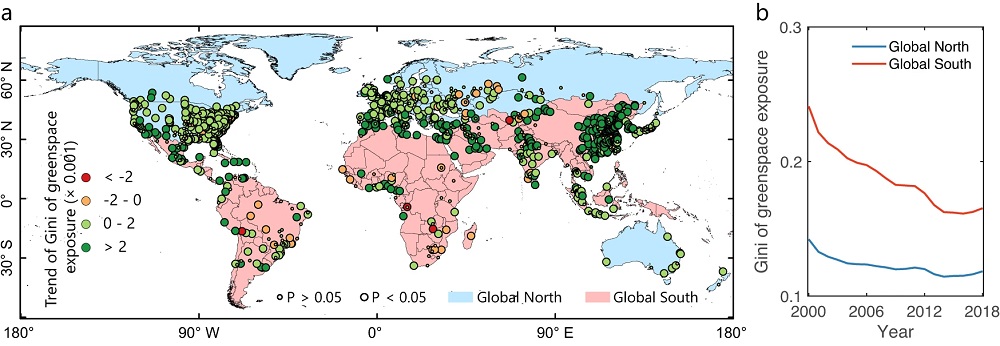
The evolution of cities has left a profound impact on green space exposure. In initial urban development stages, extensive built-up areas supplanted green spaces. The subsequent rapid urban expansion led to the construction of significant artificial green landscapes, reshaping the nature of greenspace exposure in cities. However, the extent to which urbanization has affected human exposure to green space and related inequalities over time remains unclear.
Recent research conducted by researchers from The University of Hong Kong (HKU) in collaboration with colleagues from Tsinghua University has unveiled an improved human greenspace exposure equality among global large cities. This discovery underscores the positive impact of urbanization on the accessibility and benefits of greenspaces. This research represents the first global exploration of human exposure to greenspace exposure and its associated equality shifts, focusing on the first two decades of the 21st century urbanization. The findings have been published in Nature Communications (link), providing valuable insights that can help inform future city greening efforts.
The research team developed a methodology incorporating 30-meter-resolution Landsat satellite time-series greenspace mapping and a population-weighted exposure framework to quantify the changes in human exposure to greenspace and associated equality from 2000 to 2018. The team examined 1028 cities in the world and divided their sample into two main segments: Global South (developing countries) and Global North (developed countries) cities.
Global findings indicated a substantial increase in physical greenspace coverage and an improvement in human exposure to urban greenspace. This progress led to a marked reduction in greenspace exposure inequality over the past two decades. Nevertheless, there is a contrast in the rate of reduction in greenspace exposure inequality between cities in the Global South and North, with a much faster rate of reduction in the Global South, nearly four times that of the Global North. Delving deeper into the underlying drivers, the researchers found that greenspace coverage, as a measurement of greenspace supply, has dominantly promoted the improvement in the temporal change of greenspace exposure inequality.
Dr. Bin Chen, the project's principal investigator and Assistant Professor of Division of Landscape Architecture at HKU said: "This study is a timely thrust on our earlier work published in Nature Communications, which highlighted contrasting green space exposure inequalities between cities of the Global North and Global South (link). The current research offers a comprehensive, longitudinal view of how this exposure and its associated inequalities have evolved over time".
Dr. Chen emphasized two important contributions from this study. The research findings reveal a trend toward equality in human exposure to greenspace, as reflected by a decline in inequality indices such as Gini, Atkinson, and Theil coefficients. Another key insight is that this study observes prominent spatial differences in urban greenspace trends in the contrast between Global North and Global South cities. Dr. Chen remarked: "These findings provide encouraging evidence, showcasing that cities globally are making positive progress in realizing the 11th sustainable development goal".
"The study tells a broadly positive story of the opening decades of the urban century, and our analysis of trends, and subsequent studies of positive outliers in those trends, will help cities achieve better net outcomes when planning for balanced changes in urban greenspace loss and construction by incorporating multidimensional contexts of greening history, greenspace supply status quo, prioritized vulnerable hotspots and the underlying socio-economic factors", said Professor Chris Webster, Chair Professor of Urban Planning and Development Economics, Dean of Faculty of Architecture, HKU.
Adding to the discourse, Professor Peng Gong, Chair Professor of Global Sustainability at Department of Geography and Department of Earth Sciences, Vice-President and Pro-Vice-Chancellor (Academic Development) of HKU, commented: "This research is timely and offers invaluable insights, serving as a beacon for government bodies, urban planners, and private sector developers. It emphasizes the adoption of comprehensive urban strategies to not only increase but also enhance the quality of green spaces, all in pursuit of the sustainable development goals." Professor Gong further stressed HKU's unwavering commitment to forwarding scientific research that aligns with the UN's Sustainable Development Goals. As a testament to this commitment, he highlighted HKU's recent launch of two pioneering research hubs: the Urban Systems Institute (USI) and the Institute for Climate and Carbon Neutrality (ICCN).
The full paper can be accessed here: https://doi.org/10.1038/s41467-023-41620-z
Hashtag: #HKU
The issuer is solely responsible for the content of this announcement.
About the research team
This research was led by Dr. Bin Chen, Director of Future Urbanity & Sustainable Environment (FUSE) Lab, Division of Landscape Architecture, Faculty of Architecture, Urban Systems Institute, and Musketeers Foundation Institute of Data Science, HKU. The collaborative team includes Dr. Shengbiao Wu, Research Assistant Professor, Division of Landscape Architecture, Faculty of Architecture, HKU; Professor Bing Xu, Department of Earth System Science, Tsinghua University; Professor Chris Webster, HKUrbanLabs, Faculty of Architecture, Urban Systems Institute, and Musketeers Foundation Institute of Data Science, HKU of Data Science, HKU; and Professor Peng Gong, Department of Geography, Department of Earth Sciences, Urban Systems Institute, and Institute for Climate and Carbon Neutrality, HKU.
This study is supported by The University of Hong Kong HKU-100 Scholars Fund, Seed Fund for Strategic Interdisciplinary Research Scheme Fund , the Research Grants Council of Hong Kong Early Career Scheme (No. HKU27600222) and General Research Fund (No. HKU17601423), National Key Research and Development Program of China (No. 2022YFB3903703), National Research and Development Program of China (No. 2022YFB3903703) Development Program of China (No. 2022YFB3903703), National Natural Science Foundation of China Young Scientists Fund (No. 42201373), the International Research Center of Big Data for Sustainable Development Goals (No. CBAS2022GSP04), the Croucher Foundation (No. CAS22902/CAS22HU01), and the Major Program of the National Natural Science Foundation of China (No. 2022YFB3903703). and the Major Program of the National Natural Science Foundation of China (No. 42090015).
About the FUSE Lab
FUSE Lab aims to leverage geospatial and remote sensing big data, data-model fusion, and advanced interdisciplinary approaches to investigate the interaction loops between urban environmental change, human activities, and public health, with the ultimate goal of contributing to sustainable and sustainable development. FUSE Lab aims to leverage geospatial and remote sensing big data, data-model fusion, and advanced interdisciplinary approaches to investigate the interaction loops between urban environmental change, human activities, and public health, with the ultimate goal of contributing to sustainable and FUSE lab's research focuses on four major directions: (1) Urban and Natural Environmental Changes; (2) Human- Environment Spatiotemporal Interaction; and (3) Healthy Cities. Environment Spatiotemporal Interaction; (3) Impact of Environment and Human activities on Public Health; and (4) Urban Environment Improvement Theory and Adaptation Pathway. Theory and Adaptation Pathways.
To promote knowledge exchange, more recent research activities can be viewed through https://fuselab.hku.hk/

 Hashtag.net.au


