

the new national transport plan steers NZ back to a car-dependent past
- Written by Timothy Welch, Senior Lecturer in Urban Planning, University of Auckland, Waipapa Taumata Rau
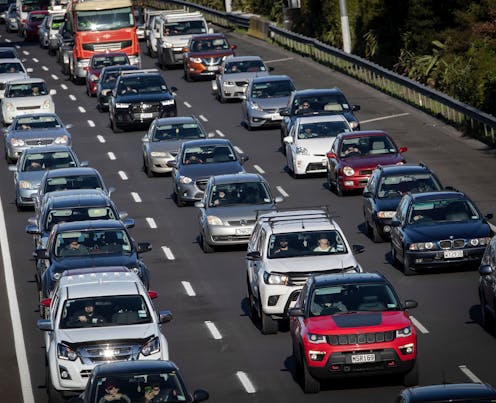
The government’s new National Land Transport Programme (NLTP) could easily have been renamed the “highway funding project”, given its intense focus on road building.
Released yesterday, the plan outlines funding priorities for the next three years. If it comes to fruition, much of the spending will be driven into major highway schemes, and steered away from sustainable transport alternatives for the main cities.
The programme allocates NZ$7 billion for state highway improvements between now and 2027, most of which goes to the newest iteration of the so-called Roads of National Significance (RoNS). On top of this massive highway bill, the programme gives another $1 billion in contingency funding to accelerated planning of the RoNS.
But the total $8 billion price tag doesn’t actually buy new highways. The roads are several years, if not decades, away from becoming a reality. Instead, these funds will be dedicated to extensive planning, design and preparatory work, rather than actual construction.
For many of those road projects, the current NLTP period focuses on route protection, environmental assessments, property acquisition and preliminary designs.
The State Highway 1 Warkworth-to-Wellsford project, for instance, will only begin construction late in this NLTP period. Others, like the East-West Link and State Highway 29 Tauriko West projects, are still in the development and route protection stages.
Even more telling, projects such as the State Highway 16 North-West alternative highway won’t see any construction during this NLTP period. Nor will the State Highway 6 Hope Bypass in Nelson, which won’t break ground until 2029.
Funding the status quo
The approach effectively commits billions in taxpayer dollars to preparatory work without delivering any tangible infrastructure improvements. New Zealanders will likely find themselves stuck in worsening traffic, waiting for highways that may never materialise.
These projects could easily be sidelined by future budget constraints or changing political priorities. A growing recognition of induced demand – where new roads generate more traffic rather than alleviate congestion – and the looming challenges of climate change risk these carbon-intensive projects being obsolete before they even begin.
Meanwhile, projects that could address far more severe congestion in the main cities are being cut back or indefinitely postponed.
Transport Minister Simeon Brown’s election promise to prioritise mending potholes – essentially a rebranding of standard road maintenance – will also significantly affect transport funding.
In all, a staggering $10.06 billion will be spent maintaining and operating the overbuilt road network, including:
$2.07 billion allocated for state highway pothole prevention
$2.3 billion for state highway operations
$3.44 billion for local road pothole prevention
$2.25 billion for local road operations.
This enormous sum, mainly dedicated to preserving the status quo, raises questions about the financial sustainability and efficiency of our current transport infrastructure model.
Back seat for public transport
The road-building focus of the new NLTP will draw funding away from projects that offer the best bet of reducing urban congestion, lowering the number of road deaths and meaningfully curbing transport emissions.
The programme pulls the plug on new cycling and walking projects, furthering the culture war Brown ignited when he took the reins as transport minister. Announcing his plan, he claimed New Zealanders were “sick and tired of the amount of money going into cycleways”.
A mere $460 million is allocated for walking and cycling over the entire three-year period, a fraction of the billions earmarked for highways.
This also represents a significant decrease from previous NLTP periods, with the document merely stating there is “no available funding for new projects” in this area.
With the focus on completing already committed projects and maintaining existing infrastructure, it’s a clear signal active transport modes have been pushed aside in favour of the government’s asphalt aspirations.
Public transport funding also falls prey to the new highway building programme. While the NLTP allocates $3.73 billion for public transport services and $2.64 billion for infrastructure, the lion’s share of this is earmarked for maintaining existing services, with very little left for expansion.
Roads to nowhere?
There is no grand vision for public transport. A mere $136 million is allocated for service improvements across the entire country. Auckland, already choking on traffic, gets a mere $100 million. Christchurch gets $8 million.
Even more alarming is the expectation of increased fare revenue and third-party funding for public transport. The transport plan involves squeezing more money out of commuters already struggling with the cost-of-living, while simultaneously starving the system of the investment it needs.
Auckland’s Northwest Rapid Transit corridor has been left dangling, its fate tied to “additional funding availability”. The message seems clear: highways are a necessity, but efficient urban transit is a luxury.
This NLTP isn’t just a missed opportunity, it’s a deliberate U-turn away from the sustainable, efficient urban transport systems the cities need. Rather than investing in New Zealanders having a genuine choice in how they move in the future, it shackles them to a car-dependent past – one pothole-free highway at a time.
Authors: Timothy Welch, Senior Lecturer in Urban Planning, University of Auckland, Waipapa Taumata Rau


 Hashtag.net.au
