

If we want more solar and wind farms, we need to get locals on board by ensuring they all benefit too
- Written by Simon Wright, Senior Research Fellow, Energy & Circularity, Gulbali Institute, Charles Sturt University
The race is on to transition to clean energy. Solar and wind farm developers are inundating regional communities in the hope they will host generation and transmission infrastructure. This extra capacity is needed to achieve the federal government target of 82% renewables in Australia by 2030.
The Clean Energy Council has estimated the capacity needed to come on line between 2026 and 2030 to hit this target. It equates to 5,400 megawatts (MW) of wind, 1,500MW of commercial solar farms and 3,600MW of rooftop solar each year.
The scale of this challenge is staggering. It amounts to an annual 240% expansion in added capacity compared to the past three years.
So how do developers entice communities to accept these projects? They typically offer payments to landholders. Community development funds are also popular, with developers helping to fund local needs such as housing and community services.
But these approaches have been inconsistent and lacking in transparency. Developers have been accused of acting opportunistically. There has been confusion and sometimes conflict between neighbours in regional communities.
In short, many regional communities feel left in the dark and short-changed. The energy transition is happening “to them” rather than “with them”. Research indicates these projects are much more likely to succeed when locals feel the project is theirs or includes them and they will share enduring benefits.
How are communities responding?
Some regional communities are taking matters into their own hands to re-balance negotiation with developers.
For example, the Wimmera Southern Mallee Collaboration in Victoria has brought together the community and the 12 energy companies with projects in the region. The state government, NGOs and trusted local consultants are supporting this work to agree a collaboration framework.
This framework will create the structure and commitments needed for energy businesses to collaborate and ensure communities benefit. These benefits include solutions to pressing local needs such as housing, childcare and other infrastructure and services.
Similarly, Hay Shire Council in the NSW Riverina has led consultation to increase community influence. The aim is to make clear to renewable developers what the locals do and don’t want.
State and federal governments as well as organisations such as the Clean Energy Council, The Energy Charter, RE-Alliance and Community Power Agency are also trying to level the playing field. One such initiative, Striking a New Deal, will support and fund one rural or regional body – a local council, association or organisation – to drive better local outcomes from local energy projects.
Yet challenges remain. Renewable energy developers are struggling to build their social licence to operate in regional communities. These challenges threaten to undermine the entire energy transition.
New business models are needed
Creative new business models are slowly emerging in Australia. One example is the community-owned Haystacks Solar Garden in Grong Grong, New South Wales. Another approach is to offer electricity rebates to residents living near wind and solar farms.
Sadly, these approaches tend to be the exception rather than the rule in Australia. Casting our eyes overseas may better inform our approach at home.
In Denmark, for example, the the Danish Renewable Energy Act has required at least 20% local community ownership for all new wind projects since 2009. Wind now generates 54% of Denmark’s electricity.
Similarly, community-owned projects play a big role in Germany’s Energiewende or energy transition. Germany boasts more than 1,700 energy communities, most of them co-operatives (55%) and limited liability companies (37%). Ownership and the ability to shape the local energy system are the key drivers for community participation.
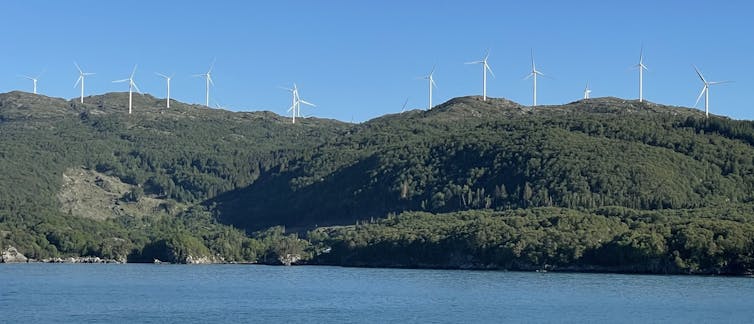
The privately owned Midtfjellet 55 wind farm in Norway is more comparable to Australian approaches. Its owners are investing €1.8 million a year (A$3 million) into local infrastructure and activities for the community of 3,100 residents.
These numbers are played out across Europe. Strong political support and a mature regulatory environment are encouraging investment from households and industry alike.
Involving and informing communities is vital
Closer to home, the Australian Energy Infrastructure Commissioner’s review of community engagement offers guiding principles of good practice. The Commonwealth-commissioned report was released in February. Its nine recommendations include “keeping communities better informed on energy transition goals, benefits and needs” and “equitably sharing the benefits of the transformation”.
Arron Wood of the Clean Energy Council welcomed the report’s findings, saying:
Community engagement and effective communication are the antidotes to the misinformation that is being used to stir division within some regional communities. Genuine engagement in good faith from all parties is needed to ensure that we get the balance right between managing community expectations and getting on with the job of building the generation, transmission and storage infrastructure that Australia urgently needs.
Importantly, the federal government has accepted all nine recommendations in principle. It recently released long-overdue national guidelines for community engagement and benefits for transmission projects.
States are also working closely with industry bodies and NGOs to provide guidance on community engagement. The NSW, Victoria and Queensland governments are offering payments to landholders for transmission projects.
Balancing regional community concerns with the need to accelerate the energy transition is clearly challenging. Government and industry appear to support a flexible approach to engagement and payments to landholders and communities. It is questionable, though, whether their concerns can be overcome without a more prescriptive, standardised approach to benefit-sharing.
Authors: Simon Wright, Senior Research Fellow, Energy & Circularity, Gulbali Institute, Charles Sturt University


 Hashtag.net.au

