

The science of the ideal salad dressing
- Written by Nathan Kilah, Senior Lecturer in Chemistry, University of Tasmania
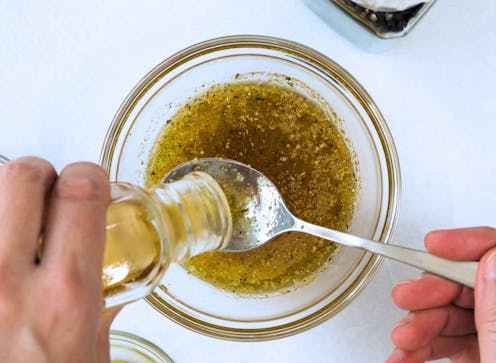
Summer means salads. And salads are even more delicious with a good dressing.
Most salad dressings are temporarily stable mixtures of oil and water known as emulsions.
But how do salad dressing emulsions form? And how can we enhance our emulsions for better salads and more?
Read more: How to make the perfect pavlova, according to chemistry experts
Oil and water don’t mix
It’s accepted wisdom that oil and water don’t mix. The water and oil molecules have distinct chemical properties that don’t interact well together.
You may have seen this if you’ve attempted to make a salad dressing by shaking together oil and vinegar (which is mostly water), which gives a temporary suspension that quickly separates.
There is a large energy cost to breaking apart and mixing the water and oil layers. The secret to blending them together is to add an extra ingredient known as a “surfactant” or emulsifier.
The name surfactant is derived from “surface active”. It highlights that these molecules work at the surface or interface to bridge the interactions between the oil and water. This is similar to how detergents are able to remove grease from your dishes.
Many vinaigrette recipes call for emulsifiers without specifically mentioning their crucial emulsifying role.
Key examples are mustard and garlic, which contain “mucilage” – a mix of carbohydrates – that can act as emulsifiers.
So if your vinegar/oil salad dressings are separating, make sure you’re adding enough of these ingredients (which also contain wonderful flavour chemicals).

Commercial salad dressings also contain naturally sourced emulsifying carbohydrates. These will often be listed on the ingredients as generic “vegetable gum” or similar, and you may need to read the label and delve a little deeper into the food additive number to find out the source.
Researchers have raised questions about synthetic emulsifiers used in processed food, as studies in mice suggest they have health risks. It’s too early to say exactly what this means for humans.
Shake it ‘til you make it
Mixing is key to dispersing oil in water. While shaking a jar is convenient, a whisk or food processor will give a more complete emulsion. The white (or opaque) colour of many emulsions is due to the formation of microdroplets that scatter light.
These mechanical mixing methods are even more essential for the formation of so-called “permanent emulsions” such as mayonnaise.
Mayonnaise is an emulsion of oil in water, but egg yolk is the key emulsifier. Egg yolks contain long molecules called phospholipids that are able to interact with both the oil layer and the water. Mayonnaise is an impressively stable emulsion, which is why is can be sold in a shelf-stable form.
But it isn’t infinitely stable; heating the mayonnaise emulsion will cause it to split. Perhaps you’ve hurriedly prepared a potato salad and added a mayonnaise-based dressing before the potatoes have cooled down?
Or toasted a sandwich spread with mayonnaise? (Incidentally, adding mayonnaise to the outside of a toasted sandwich is an excellent path to some delicious and crispy chemical reactions.)
The heat destabilises the emulsion and the separate oil and water phases will reform. Depending on the mixture, split emulsions may be recovered by adding more emulsifier and re-whisking or re-mixing.
Hollandaise sauce is a notoriously difficult emulsion to prepare. The traditional hollandaise method involves whisking egg yolk, water, and lemon juice over a low heat, then slowly adding melted butter with further whisking. Not only can the emulsion split, but you can also overcook the added emulsifying egg yolk.
The key to a successful hollandaise emulsion is separating the butter into fine, dispersed droplets, giving a thick and opaque mixture, but without cooking the eggs. Adding the butter too quickly or without sufficient mixing can give a split sauce.
Using an immersion blender can help, as can controlling the temperature of the melted butter. You might get a more consistently emulsified sauce with far less strain on your wrists.
 Mechanical mixing methods are even more essential for the formation of ‘permanent emulsions’ such as mayonnaise.
Shutterstock
Mechanical mixing methods are even more essential for the formation of ‘permanent emulsions’ such as mayonnaise.
Shutterstock
You’ve got me feeling emulsions
Emulsions are used in many more places than salads and sauces. Most medicated creams, cosmetics and lotions are emulsions of oils and water, which is why they look white.
Gardeners might be familiar with a mixture known as “white oil” – a mixture of vegetable oil and detergent. This brew, when diluted in water, is an inexpensive, effective, yet mild insecticide. Commercial versions often contain other pesticides, so make sure you read the label.
Modern acrylic paints use emulsions for both their manufacturing and application. The emulsions suspend the paint polymers in a water base.
The water from the paint evaporates, leaving a film of paint polymers that can’t be re-dispersed into water. This clever chemical trick has saved huge quantities of oil-derived solvents from being used, inhaled, and emitted into the environment from traditional oil-based paints.
Modern vaccines use emulsions to increase the immune systems response. Other common emulsions are inks, ice cream, margarine and hair products, to name just a few.
So next time you’re making a salad, check your emulsions. Opposites don’t attract, but mixing them with the right chemistry can give a delicious result.
Read more: Kitchen Science: the many wonders of humble flour
Authors: Nathan Kilah, Senior Lecturer in Chemistry, University of Tasmania
Read more https://theconversation.com/the-science-of-the-ideal-salad-dressing-216159


 Hashtag.net.au
