

how Doctor Who shapes public attitudes to science
- Written by Lindy Orthia, Senior Lecturer in Science Communication, Australian National University
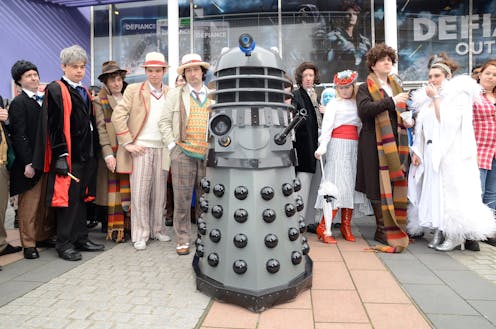
Scientists and science fans love to discuss the science in Doctor Who.
We’re interested in how its theories and gadgets stack up against real science and technology (really, really interested).
We care about gender equity among Doctor Who’s scientist characters, and the cultural significance of casting Jodie Whittaker as the first female Doctor.
Read more: The new Doctor Who picks up the chase with a pace as she crosses the gender barrier
As long ago as 1985, Britain’s Royal Society wondered whether they could use Doctor Who to promote greater public understanding of science.
Given that we care so much, one might expect to see strong evidence that Doctor Who shapes how its viewers think and feel about science. But there has been no peer-reviewed research in this area, only anecdotes from a few scientist-fans.
Until now.
In my research, published in the Journal of Science Communication, I surveyed 575 science-interested Doctor Who viewers, asking whether and how the show contributed to their relationship with science.
Many of them said it did. But as it turns out, not in consistent ways.
Thoughts about science
I recruited the 575 people via ScienceAlert; they were 59% female, 40% male and 1% non-binary or gender-fluid. They were aged 18-73, and were drawn from 37 nations, predominantly Australia (50%) and the United States (24%).
Of the 575 respondents, 398 said Doctor Who influenced their thoughts about science in one way or another.
Just over 300 respondents said the show contributed to their ideas about science ethics, the relationship between science and the rest of society, and/or the place of science in human history.
Most commonly, Doctor Who prompted people to think more deeply about the ethics of science, including its moral ambiguity and potential for doing both good and bad. Second to that, many said Doctor Who demonstrated science’s importance in society and history.
However, individual participants sometimes drew opposite conclusions about the show’s moral messages. For example, one participant said their take-home message from Doctor Who on science ethics was:
Strong ethical guidelines and laws need to exist, and be enforced.
But for another participant it was precisely the opposite:
We should stop putting ethics in the way of scientific research.
Choosing science
Beyond shaping people’s attitudes, Doctor Who had a material impact on a few people’s life choices too.
It influenced 74 participants’ education choices and 49 participants’ career choices. It sparked interest in pursuing diverse science (and other) fields including physics, astronomy, maths, engineering, computer science, environmental science, chemistry, psychology, science teaching, and science communication.
People said things like:
It made me want to learn more about science. I became a science major [because] of it.
And:
I have a degree in Environmental Science specifically because of watching the 4th Doctor deal with oil rigs. That and the Exxon Valdez made me want to change things.
Some respondents said Doctor Who simply instilled a love of learning in them or made them proud of achieving academic success.
Just a TV show?
The survey responses go far beyond the previous anecdotes from fans about how much they love science and Doctor Who. It gives us lots of new evidence to analyse – some 58,000 words of qualitative data. But the responses were far from unanimously positive.
In the survey group, 107 people answered “no” to all or most of my key questions, indicating Doctor Who had not contributed to their relationship to science in any of the ways I asked about.
They gave a range of reasons. Some came to Doctor Who too late, after their views on science had already formed. Or other factors such as school or family determined their attitudes to science and life decisions, so Doctor Who wasn’t important (gasp!).
Others were more cynical, generally mocking the notion of science fiction influencing them at all, or arguing that Doctor Who’s depictions of science were too inaccurate, fantastical or trivial to have an impact.
Some responses were neither particularly positive or negative, with Doctor Who simply validating or reinforcing people’s existing ideas about science.
So will Doctor Who create a planet of scientists?
Part of the job for some science communicators, science teachers and scientists is to inspire people’s interest in science.
My study shows that engaging with a science-rich television program can have a profoundly inspiring effect on a person’s attitudes to science. In fact, their life might be changed because of it.
If that kind of inspiration is your goal, it is worth investing in science-rich television fiction as a science engagement medium.
But don’t get too excited. Not everyone’s science attitudes are affected by the same program. Any positive effects may be minor, rather than life-changing. And two viewers may interpret the science on screen in completely different ways. Also, my participants volunteered to participate, so the numbers don’t necessarily represent statistical patterns among Doctor Who viewers generally.
Read more: Doctor Who vs real world science: who comes up trumps?
This backs up what science communication researchers have been saying for years. Television audiences aren’t ignorant dupes brainwashed by what they watch. People watch television fiction critically, aware it is fiction. All of us bring our existing knowledge, beliefs, fears and ideals to the viewing experience and make our own meanings from it in light of them.
What science-rich fiction can do, though, is set an agenda. It can offer people new frameworks for pondering science questions and provoking conversations about them.
So despite the caveats, if we want to nurture a society of people who think about science more keenly, more critically and more often, we could do worse than plug the next season of Doctor Who.
Authors: Lindy Orthia, Senior Lecturer in Science Communication, Australian National University


 Hashtag.net.au
