

As Stolen Generations survivors ‘pass away at a rapid rate’, some still await official redress
- Written by Narelle Bedford, Associate Professor, Faculty of Law, Bond University
Aboriginal and Torres Strait Islander readers are advised this article contains names, images and voices of deceased people.
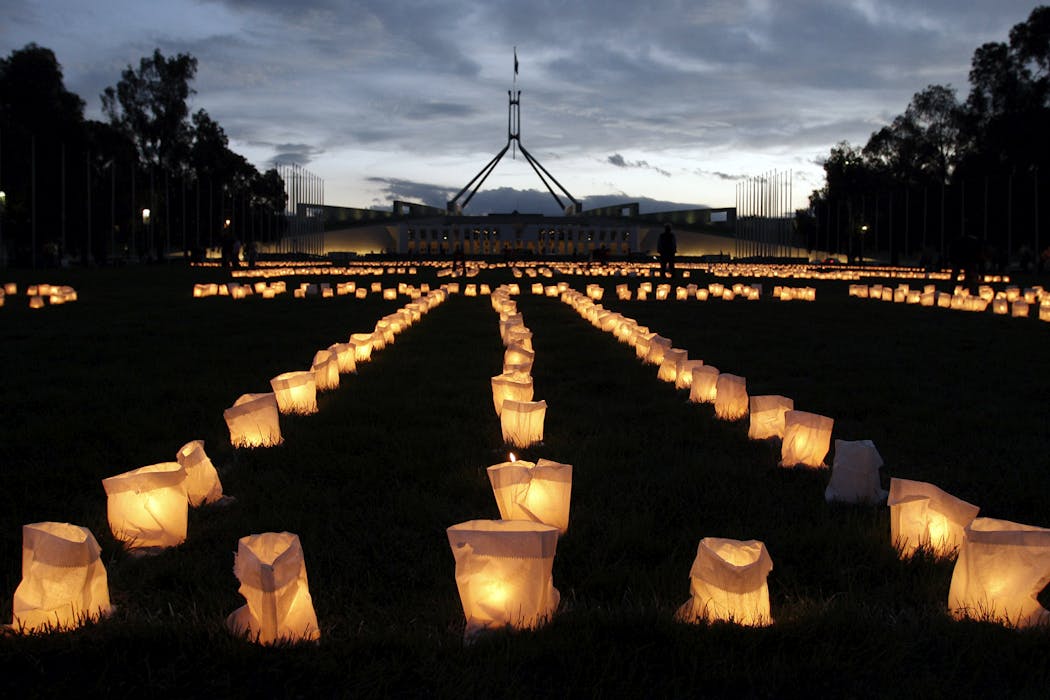
Today marks 18 years since then prime minister Kevin Rudd’s apology to more than 27,000 Stolen Generation survivors for policies that “inflicted profound grief, suffering and loss”.
The ripple effects of taking thousands of children from their families continue today.
Many Indigenous Australians – like me – grew up in families where at least one relative was removed as a child. Some never saw their families again.
I’ve spent six months researching different states and territories’ redress schemes, and what’s worked best.
That research shows the compensation available varies hugely, depending on which state or territory survivors were taken from. This is especially true in Queensland, the only state without any redress scheme.
I presented the results of my research at the National Indigenous Legal Conference late last year. I’m sharing those findings now, ahead of formal publication, because too many survivors are growing old waiting for action.
What redress has there been so far?
Apart from Queensland, every other state and territory has offered some financial and non-financial forms of compensation for Stolen Generations survivors. Some schemes – New South Wales, South Australia and Tasmania – are closed to new applications.
Many survivors and their families have said practical forms of redress had often made the biggest difference to their lives. These included:
Money alone cannot repair the harms done to survivors. Those harms include the devastating impacts of losing contact with family, suffering racial discrimination, physical, sexual and emotional abuse, and being stripped of cultural, economic and potential native title rights.
But financial compensation still matters. The amounts survivors can apply for vary across different state and territory schemes, ranging from $30,000 in South Australia to $100,000 in Victoria.
It’s been 18 years since the federal government’s apology to the Stolen Generations on February 13 2008.One state is yet to act
Queensland remains the only state without any redress scheme. Yet the 2021 census showed the state is home to more than one in four Aboriginal and Torres Strait Islander people in Australia.
In 2024, Queensland’s Liberal National government repealed the Path to Treaty Act and abandoned the state’s truth and healing inquiry. The government has stressed it’s “committed to practical reconciliation”.
For Queensland survivors, there’s no more time to wait for practical action on a redress scheme.
What’s worked and what’s missing
Balancing the schemes’ financial and non-financial aspects, my analysis concluded Victoria and Tasmania have delivered the most positive redress schemes.
For example, Tasmania’s scheme allows children of Stolen Generations survivors who have died to apply for payments. This reflects the hard reality that taking a child from their family has multigenerational effects.
A 1997 documentary tied to the Bringing Them Home report, featuring Stolen Generation survivors explaining the lasting impacts of being forcibly removed from their families.A longer version of my research will be published in an academic journal later this year. My pre-print findings make 14 recommendations for best practice redress schemes, including:
- removing arbitrary closing dates
- allowing survivors’ descendants to apply
- funding for practical cultural restoration, such as to learn languages or reconnect to Country
- and offering financial compensation on par with Victoria’s $100,000 for those taken as a child by compulsion, duress or undue influence.
That amount of money is far less than a court has previously ruled was a fair reflection of the damages done.
One survivor’s story
On Christmas Day 1957, 13-month-old Bruce Trevorrow was sick with stomach pain and diarrhoea.
His family didn’t have a car and lived hours from Adelaide children’s hospital. His father was caring for three older siblings, so asked neighbours to take his baby on the long drive.
In the weeks and months that followed, his parents pleaded for news of their boy. As his mother wrote to the Aboriginal Protection Board:
I am writing to ask if you will let me know how baby Bruce is and how long before I can have him home
The board wrote back, saying her son was “making good progress”. But he had been fostered to a white family, just a fortnight after being admitted to hospital.
By the time Trevorrow saw his family again, years later, his father was dead.
In 2007, South Australia’s Supreme Court awarded the 50-year-old Trevorrow $775,000 in damages and interest.
Trevorrow died less than a year later.
‘Are you waiting for us to die?’
A 2025 report, “Are You Waiting For Us to Die?”, found just 6% of the 1997 Bringing Them Home inquiry’s recommendations to support Stolen Generations survivors and families had been implemented.
As Healing Foundation chair and Kungarakan man Steve Larkin said last year:
Nearly 30 years since its tabling, survivors are passing away at a rapid rate.
Survivors’ medical, psychological and care needs are becoming more acute with age.
Additionally, some can resist needed aged care services, due to fears of institutionalisation. Places at Aboriginal-controlled aged care centres, run with cultural care and sensitivity, are very limited.
We need more meaningful reform for the remaining Stolen Generation survivors, before it’s too late.
Authors: Narelle Bedford, Associate Professor, Faculty of Law, Bond University

 Hashtag.net.au
