

Why does mint make water taste so cold? A scientist explains
- Written by Christopher Stevens, Associate Professor, Sport and Exercise Science, Southern Cross University
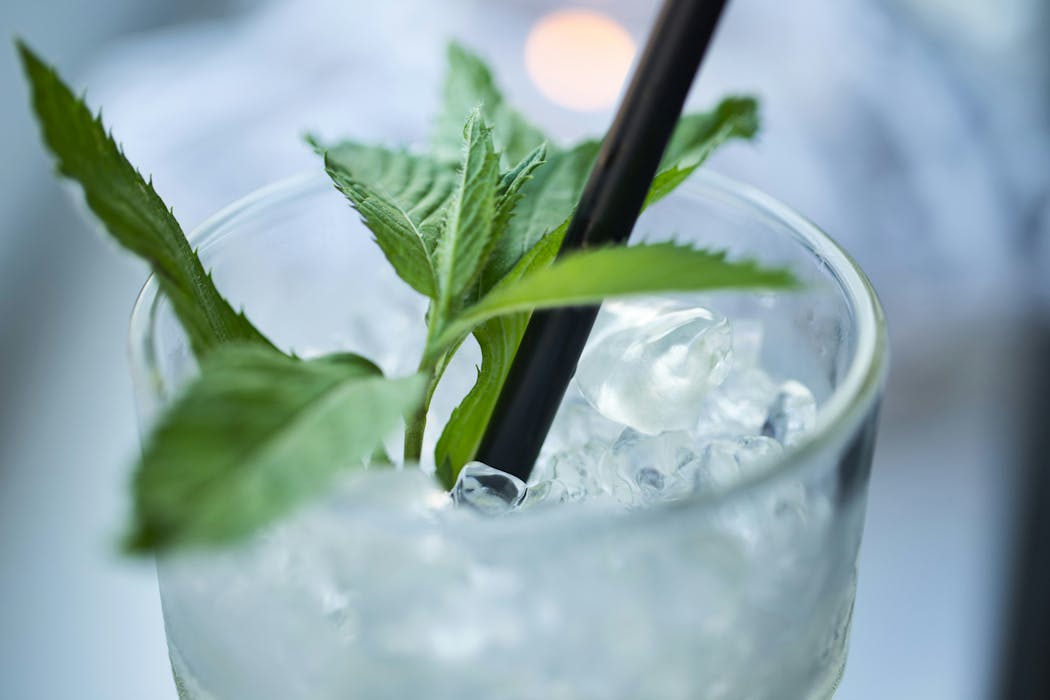
You’ve just cleaned your teeth, you’re feeling minty fresh and ready to climb into bed. You take a sip of water, but the water is icy cold, and your next breath feels cool and crisp.
What has the toothpaste done to your mouth? And could this be a hack to help you feel cooler when you really need it?
Tricking the brain
Menthol, a natural compound that comes from mint plants, is the ingredient in toothpaste that creates the feeling of cold.
Menthol activates TRPM8 receptors on nerve endings in your mouth, which are the same receptors responsible for sensing cold. So, menthol essentially tricks your brain into sensing cold, in the same way that chilli tricks your brain into sensing heat.
It does so by binding to TRPM8 receptors and changing their shape, allowing calcium to enter and trigger a signal to the brain which is interpreted as a sensation of cold.
When you have a drink of water or take a breath of air with menthol in your mouth, the menthol spreads all over and more receptors are activated, increasing its effect.
The receptors are now open and primed to sense cold, so any liquid or air that is somewhat cool will feel even colder than it really is.
Why is menthol in so many products?
Companies use this action of menthol to create another dimension to the flavour and feel of their products.
Menthol is added to toothpaste and chewing gum to create a cool refreshing feeling that signals “cleanliness”, and to cough drops to create the feeling of open airways. Menthol doesn’t physically cause decongestion – it just enhances sensitivity and a sensation of coolness in the airways, which makes it feel like more air is passing through.
Menthol can cool the skin as well through the same receptors. That’s why menthol is commonly added to topical creams designed for pain relief.
Menthol’s cooling sensation can also act as a “counterirritant”, where the menthol activates pain receptors in the skin causing irritation, and then desensitises them, which can reduce the underlying pain. Studies have shown topical menthol can be an effective treatment for pain from muscle soreness, cancer treatment-related neuropathic pain and migraine.
Menthol as a sports supplement
The cooling effect of menthol might even be beneficial for exercise and sport. In one study, my colleagues and I found that a menthol mouth rinse reduced how hot runners felt and allowed them to run faster in a five-kilometre time trial in 33°C.
Interestingly, the menthol mouth rinse was more effective than drinking a slushie, which physically reduced body temperature, but didn’t make the runners feel cooler or run faster.
As such, how hot you feel may be more important that how hot you are – at least for running performance.
The Australian Institute of Sport has categorised menthol as a group B sport supplement, meaning it has “emerging and/or mixed scientific support, deserving of consideration in specific populations or situations”.
Research has now shifted to adding menthol to energy gels. In one study, my colleagues and I tested energy gels with different menthol concentrations to determine the optimal amount to maximise the cooling effect. This could allow menthol to be more accessible during exercise and sport.
The use of menthol in sport is controversial, because it might make a person feel cooler when exercising in the heat, and allow them to push beyond their thermal limits. In theory, this could increase the risk of overheating and exertional heat illness – a continuum of conditions from muscle cramps to heat exhaustion, to the life-threatening condition of heat stroke.
However, this hasn’t been an issue in the research published so far. An international consensus statement concluded that menthol supplements are safe when prepared and implemented according to guidelines, and don’t provide an unfair advantage or violate the spirit of sport. So, menthol isn’t currently a banned substance in sports.
The use of menthol in products is likely going to become even more common in the future. The next time you feel an unexpected cooling sensation from a food, drink or cream, the ingredients list will tell you if it’s menthol playing a trick on you.
Authors: Christopher Stevens, Associate Professor, Sport and Exercise Science, Southern Cross University
Read more https://theconversation.com/why-does-mint-make-water-taste-so-cold-a-scientist-explains-267550


 Hashtag.net.au
