

Why endurance events like marathons should have weight divisions for heavier runners
- Written by Brendon Hyndman, Associate Dean (Academic), Faculty of Arts and Education, Charles Sturt University
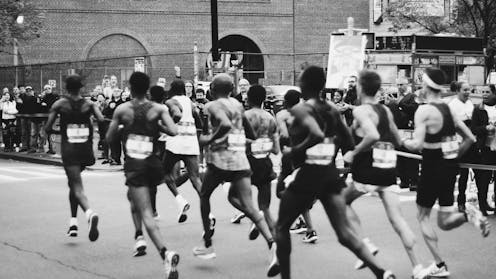
In sports such as wrestling, boxing, rowing, weight lifting and the martial arts, athletes are grouped by weight to make things fairer.
It wouldn’t make sense for someone who weighs 60 kilograms to fight someone who weighs 100kg, because the bigger person usually has more power.
That’s why weight divisions exist, so the result depends more on skill than just size and strength.
While some endurance events incorporate weight divisions, they rarely feature in running’s toughest events like marathons.
Triathlons leading the way
Weight divisions are becoming common in some endurance sports, such as triathlons.
Categories such as Clydesdale (for heavier men) and Athena (for heavier women) are used, usually for people who weigh more than 90-100kg.
These divisions give bigger athletes a chance to race against others like them, which many believe makes the competition feel fairer.
Of the three modes in Ironman distance triathlons (running, cycling and swimming), running has been recognised to be the most affected by a person’s body type.
Yet many marathons still don’t have weight divisions, especially in Australia, where the marathon scene continues to progress: Sydney’s upcoming marathon was recently announced as the seventh member of the Abbott World Marathon Majors, joining the world’s most prestigious events.
So why aren’t weight divisions a part of Australia’s marathon scene?
Some people think running is about personal achievement, not competition, so there’s no need for different categories.
Others believe adding weigh-ins could be awkward or hard to organise.
And some just prefer keeping things the way they’ve always been.
Running gets harder if you’re heavier
Age groupings are provided by most endurance events, yet research suggests body weight also needs to be considered as a major predictor of running performance in marathons.
Scientists and running experts agree: being heavier makes running harder.
It’s not about effort or determination, it’s about physics.
If you weigh more, it takes more energy to move your body. You get tired faster, your joints take more impact and your heart works harder.
That’s just how the body works.
A slender body type has been widely recognised by research as having greater success in marathon running.
Larger body types are generally more suited to sports such as rugby, although many of course enjoy endurance running events.
Here’s a practical example. Analysing the times of 20,000 runners across running events lasting more than 10 kilometres, an accountant in the United States discovered a 95kg man who runs a 10km event in 51 minutes is performing as well as a 68kg man who finishes in 38 minutes.
Heavier runners are often slower and more vulnerable to the increased stress on their bodies.
This can reduce running efficiency, even if they train just as much as lighter runners.
That doesn’t mean they’re less fit or less committed, it just means that due to carrying more weight, they are often dealing with more air resistance, increased forces on their body, challenges on hills and are less able to regulate their body temperature through every kilometre.
There are now weight versus pace calculators that can predict a 100kg athlete who can run a marathon in four hours could be 10 minutes quicker if they lost five kilograms.
Others refer to the “1% rule” which outlines a 1% increase in body weight can drop running pace by the same percentage.
Some endurance running events are now including weight divisions – mainly in the United States but they’re also starting to emerge in Canada and New Zealand.
Heavier athletes are often disadvantaged in endurance running events.Arguments for and against
There are some good reasons to try this.
Some heavier runners feel left out of the sport because they don’t look like the slender runner’s body stereotype.
Research of heavier runners and triathletes has shown they can feel like outsiders. Even when they are doing well in races, people can act surprised, as though they didn’t expect someone big to be a good runner.
So it’s not just a physical challenge, it’s also a social one.
Weight divisions could make racing feel more fair, encourage more people to join in and help heavier runners feel recognised for their hard work.
Yet there are also some downsides. For example, weighing people before races might make some feel uncomfortable or embarrassed.
Some people also worry it could lead to body image issues or make running feel more focused on weight than fitness.
Adding weight divisions could also create more organisational work, with additional trophies and weigh-ins needed.
Some research suggests women are less favourable to having weight divisions than men.
Still, the research suggests weight plays a big role in running performance and dividing races by weight might help more people enjoy the sport.
It’s not a perfect solution but it’s something worth thinking about if we want to make marathons more welcoming for everyone.
Authors: Brendon Hyndman, Associate Dean (Academic), Faculty of Arts and Education, Charles Sturt University

 Hashtag.net.au
