

we found cockatoos have 30 different dance moves
- Written by Raf Freire, Senior Lecturer in Animal Behaviour and Welfare, Charles Sturt University
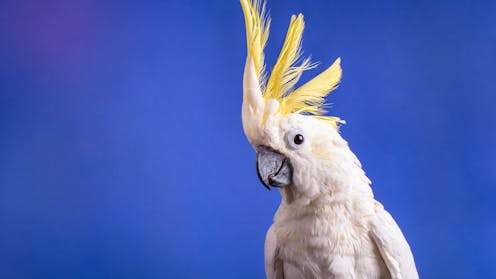
Companion cockatoos are renowned for their problem-solving and intriguing characters. It’s no surprise these large, long-lived and intelligent parrots are known to display complex behaviour.
Owners often film their birds dancing to music and post the videos to social media. Snowball, a famous dancing cockatoo, has been shown to have 14 different dance moves.
We wanted to find out more about the dance repertoire of cockatoos and why they might be doing this. In our new research, we examined videos of dance behaviour and played dance music to six cockatoos at an Australian zoo.
These birds weren’t just doing a side step or bobbing up and down. Between them, they had a rich repertoire of at least 30 distinct moves. Some birds coordinated their head bobbing with foot movements, while others undertook body rolls. Our research shows at least 10 of the 21 cockatoo species dance.
If we saw this behaviour in humans, we would draw a clear link between music and dancing and interpret the behaviour as enjoyable. After watching cockatoos voluntarily begin dancing for reasonable lengths of time, it was difficult to reach any conclusion other than cockatoos most likely dance because it’s fun.
A Goffin’s cockatoo dancing while a Guns and Roses song plays.How many moves does a cockatoo have?
Dancing is complicated. To dance to music, animals need to be able to learn from others, imitate movements and synchronise their movements. These complex cognitive processes are only known to exist in humans – but evidence is emerging for its presence in chimpanzees and parrots such as cockatoos.
To catalogue the dance moves of cockatoos, we began by studying videos of the behaviour. We analysed 45 dancing videos and recorded all distinct moves.
The five species in these videos were the familiar sulfur-crested cockatoos and little corellas, as well as Indonesian species such as Goffin’s cockatoos, white cockatoos and Moluccan cockatoos.
Across the videos, we spotted 30 movements, including 17 that hadn’t been described scientifically. We also observed 17 other movements, which we classified as “rare” because they were only seen in a single bird.
Head movements were the most common dance move, especially the downward bobbing motion. Half of all videoed cockatoos performed this move.

Dancing – but not to music
Once we catalogued the moves, we then tested whether music could elicit this behaviour in captive cockatoos who weren’t kept as companions.
We undertook a playback experiment with six adult cockatoos at Wagga Wagga Zoo in New South Wales, comprising two sulfur-crested cockatoos, two pink cockatoos and two galahs.
Over three sessions, we played a piece of electronic dance music on repeat for 20 minutes and recorded any responses on video. We repeated our experiment with no music and again with a podcast featuring people talking.
All six cockatoos we studied showed some dancing behaviour at least once over the three sessions. But the rates of dancing weren’t any higher during the playing of music – it was similar to dancing during silence and the podcast.
We don’t fully know why this is. One possibility could be because we played music to existing male-female pairs, and the social environment alone was sufficient to trigger dance behaviour.
Why do cockatoos dance at all?
To find out whether the cockatoo species most prone to dancing were those most closely related, we analysed similarities across species. Goffin’s cockatoos and white cockatoos had the most similar moves, while Goffin’s cockatoo and little corella were the furthest apart.
But this clashed with genetics, as Goffin’s cockatoos are most closely related to little corellas. This suggests dancing behaviour may not be connected to genetic links.
Interestingly, these behaviours are mainly recorded in companion birds. Music playback in the online videos does seem to encourage the bird to keep it going for longer than likely to be seen in zoo or wild birds. These dance moves might represent an adaptation of courtship display movements as a way to connect with their human owners.
Other researchers report being able to trigger dancing behaviour in an African grey parrot and a sulfur-crested cockatoo with music. But the zoo cockatoos in our playback study didn’t respond the same way. This suggests there may be an element of learning to respond to humans.
A galah bobs and side steps while a song plays. But it’s not clear the movements are a response to the music.It’s usually easy to tell if a human behaviour is play or not. But in animals, it can be much more difficult. Researchers define a behaviour as play if it meets four criteria: it occurs while animals are relaxed, it’s begun voluntarily, has no obvious function and appears rewarding. Cockatoo dancing would meet all four of these criteria.
By contrast, repetitive behaviours such as pacing seen in animals kept alone in small cages would not be play – it’s not rewarding and the animals don’t seem relaxed. Parrots kept in poor conditions exhibit self-harming behaviours such as constant screeching and feather pulling.
Captive parrots have complex needs and can experience welfare problems in captivity. Playing music may help enrich their lives.
For cockatoo owners, this suggests that if their birds are dancing, they’re feeling good. And if they’re busting out many different moves in response to music, even better – they might be showing creativity and a willingness to interact.
Acknowledgement: Honours student Natasha Lubke is the lead author of the research on which this article is based.
Authors: Raf Freire, Senior Lecturer in Animal Behaviour and Welfare, Charles Sturt University

 Hashtag.net.au
