I heard that we see upside down, but our brain flips the image. How does it do that?
–Jasmine, Mount Evelyn, Victoria
Our eyes work thanks to light. Objects we can see are either sources of light themselves – like a candle or a phone screen – or light bounces off them and makes its way to our eyes.
First, light passes through the optical components of the eyes such as the cornea, pupil and lens.
Together, they help focus the light onto the retina that senses light, while also controlling the intensity of light to help us see well while avoiding damage to the eye.
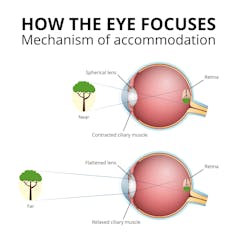
The function of the lens is to correctly focus light that comes from objects at different distances. This process is known as accommodation.

Marochkina Anastasiia/Shutterstock
While performing this important task, light passing through the lens becomes inverted. This means that light from the top of the object falls lower on the retina than light from the bottom, which falls higher on the retina.
So, light exiting the lens to land on the retina is indeed flipped upside down. But that doesn’t mean the brain is actually flipping the picture “back”. Here’s why.
The orientation doesn’t actually matter
While the light being interpreted by the brain is “upside down” compared to the real world, the question is: is that actually a problem for us?
From your own experience you can tell the answer is probably no. We seem to navigate and interact with the world just fine.
So, where in the brain is the image flipped or rotated 180 degrees to be the “right way up” again?
You may be surprised to learn that vision scientists reject the idea a flipping or rotation needs to happen at all. This is because of how our brains process visual information.
The object you perceive is “encoded” by the firing of various neurons – brain cells that process information – in various locations in the brain. This pattern of firing is what encodes the information about the object you’re focusing on. That info takes into account the object’s relation to everything else in the scene, your body in the world, and your movements.
As long as the relative encodings of these are all consistent with one another, as well as stable, there’s no need for a flip to happen at all.
We can function with ‘upside down’ goggles!
Several studies have looked at how we adapt to large changes in visual input by asking people to wear goggles that flip the image coming in.
This means the image lands on the retina the “right way up”, so to speak, but upside down from what the brain has learned it should be.
In the 1930s, two scientists in Austria performed the Innsbruck Goggle Experiments. For weeks or even months at a time, participants in these studies wore goggles that altered the way the world around them looked. This included goggles that turn the incoming image upside down.
As you can imagine, people wearing these goggles at first found it really difficult to get by in their day-to-day activities. They would stumble and bump into things.
But this was temporary.
Participants reported seeing the world upside-down for the first few days, with difficulties navigating the environment, including trying to step over ceiling lights that appeared to them as on the floor.
Around the fifth day, however, performance seemed to improve. Things that were at first seen upside down now appeared the right way up, and this tended to improve with more time.
In other words, with continued exposure to the upside-down world, the brain adapted to the changed input.
More recent studies are beginning to identify which areas of the brain are involved in being able to adapt to changes in visual input, and what the limits of our ability to adapt might be.
Adaptation may even allow “colour blind” people to see colour better than is predicted from their condition.
Authors: Daniel Joyce, Senior Lecturer in Psychology, University of Southern Queensland
Read more






 Hashtag.net.au

