

Can you tell the difference between real and fake news photos? Take the quiz to find out
- Written by T.J. Thomson, Senior Lecturer in Visual Communication & Digital Media, RMIT University
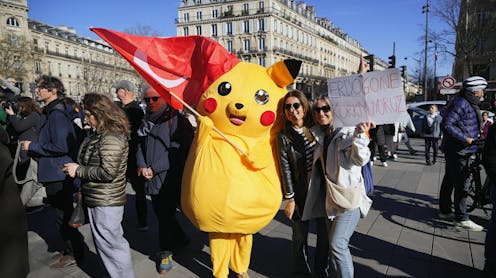
You wouldn’t usually associate Pikachu with protest.
But a figure dressed as the iconic yellow Pokémon joined a protest last week in Turkey to demonstrate against the country’s authoritarian leader.
And then a virtual doppelgänger made the rounds on social media, raising doubt in people’s minds about whether what they were seeing was true. (Just to be clear, the image in the post shown below is very much fake.)
This is the latest in a spate of incidents involving AI-generated (or AI-edited) images that can be made easily and cheaply and that are often posted during breaking news events.
Doctored, decontextualised or synthetic media can cause confusion, sow doubt, and contribute to political polarisation. The people who make or share these media often benefit financially or politically from spreading false or misleading claims.
How would you go at telling fact from fiction in these cases? Have a go with this quiz and learn more about some of AI’s (potential) giveaways and how to stay safer online.
How’d you go?
As this exercise might have revealed, we can’t always spot AI-generated or AI-edited images with just our eyes. Doing so will also become harder as AI tools become more advanced.
AI-powered tools exist to try to detect AI content, but these have mixed results.
Running suspect images through a search engine to see where else they have been published – and when – can be a helpful strategy. But this relies on there being an original “unedited” version published somewhere online.
Perhaps the best strategy is something called “lateral reading”. It means getting off the page or platform and seeing what trusted sources say about a claim.
Ultimately, we don’t have time to fact-check every claim we come across each day. That’s why it’s important to have access to trustworthy news sources that have a track record of getting it right. This is even more important as the volume of AI “slop” increases.
Authors: T.J. Thomson, Senior Lecturer in Visual Communication & Digital Media, RMIT University

 Hashtag.net.au
