

Australia’s superb lyrebirds ‘farm’ the forest floor to increase their prey – a behaviour rarely seen in nature
- Written by Alex Maisey, Postdoctoral research fellow, Research Centre for Future Landscapes, La Trobe University
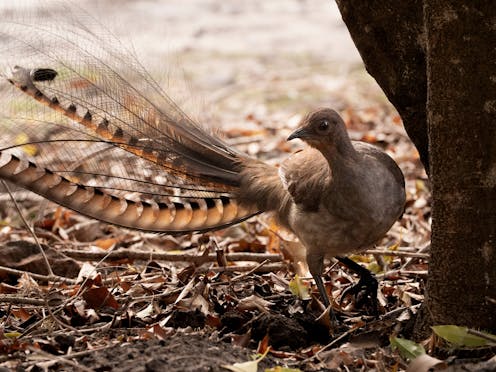
In wet forests of southeastern Australia, superb lyrebirds engage in extraordinary behaviour – tilling the soil to create habitats for their prey to flourish.
The superb lyreird scratches through the leaf litter and topsoil while foraging, using its powerful claws to search for invertebrates such as worms, centipedes, spiders, crustaceans and insects.
This loosens the soil, allowing more air and water to infiltrate, and speeding up the decomposition of organic material. Our new study shows this creates an ideal habitat for the invertebrates on which it feeds – ensuring they grow large and ensuring the lyrebirds’ future buffet.
So, lyrebirds essentially “farm” their food resource by cultivating the forest floor. This behaviour is rarely seen in the non-human world. It extends across millions of hectares, potentially delivering far-reaching benefits to forest ecosystems.
A remarkable species
The superb lyrebird is mainly found in moist eucalypt forests in southeastern Australia. It is known for its mimicking song and, in the case of the males, ornate, lyre-shaped tail feathers.
Lyrebirds are considered “ecosystem engineers”. This means their foraging changes the environment in ways that affect other species.
Our previous research has shown superb lyrebirds can move an astounding 155 tonnes of litter and soil per hectare of forest floor each year.
The scale of this disturbance suggests it must affect the invertebrates that live in the soil, including those on which lyrebirds rely for their food. Did this in turn benefit the lyrebirds themselves? Our research set out to test this.
What our research involved
Our two-year project involved three sites in the tall forests of Victoria’s Central Highlands.
At each site, we established three experimental plots (3m × 3m), each involving a different “treatment”.
The first treatment involved fencing off the plot to create a lyrebird-free environment. We left these areas alone for two years.
The second treatment also fenced out lyrebirds. But at these, we visited monthly to rake the litter and soil, mimicking lyrebird foraging and scratching. We used a three-pronged, claw-like rake the same width as a lyrebird’s foot. But unlike the lyrebird, we didn’t eat the bugs we encountered!
In the third treatment, we marked the plots with metal stakes, but no fence. This allowed lyrebirds to forage as they pleased.
We collected a sample of soil and leaf litter from each plot at the start of the study, and then again in each spring season.
Then, with help from a specialist insect scientist, known as an entomologist, we counted and classified the invertebrates in the samples – a whopping 197,880 creatures in all.
What we found
We compared samples from the fenced plots – both those that excluded lyrebirds and prevented them feeding, and those where we raked to mimic lyrebird foraging.
We found the raked plots had more types and a larger amount of invertebrates than the undisturbed plots. This suggests turning over the litter and soil creates conditions for invertebrates to thrive and grow bigger.
Then we compared samples from the raked plots and plots where lyrebirds had been free to forage. Again, invertebrates in the raked areas were bigger and more diverse. This was because in both treatments invertebrates had increased, but some had been eaten by lyrebirds in the unfenced plots.
These results provide evidence – albeit unsurprising – that lyrebird feeding affects the invertebrate community on the forest floor. But it also shows that lyrebird cultivation of the litter and soil allow invertebrates to rapidly increase in number and type, replacing what lyrebirds harvest.
Big benefits for forests
Our research shows lyrebirds scratch and modify the forest floor in ways that promote bigger and more diverse food sources. This makes it one of only a few non-human animals known to farm their prey.
Other well-known examples include leaf cutter ants in South America, which grow elaborate fungus “farms” in their nest chambers. The ants weed out unpalatable fungi and select premium leaf matter to feed their crop.
And in West Africa, foraging by both the greater flamingo and the fiddler crab changes mudflats in ways that increase algal biofilms, their shared food resource.
The interaction between lyrebirds and invertebrates has wide benefits for forests. Invertebrates help cycle nutrients and disperse seeds. They also provide food for many birds, small mammals and reptiles.
In this way, the superb lyrebirds’ farming-type behaviour plays an important role in maintaining forest biodiversity. This fascinating behaviour also provides yet another reason to celebrate the complexity of nature.
Authors: Alex Maisey, Postdoctoral research fellow, Research Centre for Future Landscapes, La Trobe University


 Hashtag.net.au
