

Loss of forests brought new birds to NZ during the last Ice Age – we’re witnessing a similar process now
- Written by Pascale Lubbe, Postdoctoral Research Fellow in Molecular Ecology, University of Otago
When people arrived on the shores of Aotearoa New Zealand and began to turn the land to their needs, they set in motion great changes.
The landscape of today bears little resemblance to that of a mere thousand years ago. More than 70% of forest cover has been lost since human arrival. Native bush has been replaced by tussocks, scrublands and, most of all, open agricultural land.
These changes affected our birdlife dramatically. Some species, like the moa, were simply hunted to extinction. Others fell directly to mammalian predators. Many species were victims of severe habitat destruction. The loss of suitable habitat remains a key conservation challenge to this day.
However, a changing distribution of plants is not a uniquely modern feature. New Zealand has seen equally radical shifts in habitat before – during the Ice Age, which lasted 2.6 million years and ended about 12,000 years ago.
At its height, parts of the country were up to 6°C colder than today, and glacial ice sheets spread wide fingers across the Southern Alps. The dry, cold climate resulted in widespread grass and scrubland. Forest cover became patchy everywhere except for the northern North Island.
Our new research tracks how bird life responded to these changes – in particular how exotic species took advantage of the shifting landscapes to make New Zealand home.
Ice Age invaders
Native birds responded to the Ice Age in a variety of ways. Kiwi populations became so isolated in forest patches they split into new lineages. Several moa species moved across the landscape, following their shifting habitat.
Some groups adapted, spreading into novel environments. Kea split off from their relatives the kākā, becoming more generalised. This is known as in situ adaptation; an existing group changing its habits or character to deal with new environments.
But where new ecological opportunities arise, species from elsewhere will also come to take advantage of them. Our research uncovers a pulse of colonisation by exotic bird species that coincides with the reduction of forest cover and the expansion of grasslands at the start of the Ice Age some 2.6 million years ago.
These species were primarily generalists, able to take advantage of a variety of habitats. But there was also an influx of birds pre-adapted to more open conditions, such as the ancestors of Haast’s eagle, pūtangitangi (paradise shelduck) and pīhoihoi (pipit).
Where did these “invaders” come from? Principally, from Australia. For millions of years, they have ridden the winds across the Tasman Sea and, occasionally, established breeding colonies on our shores.
Over a long enough time, those new populations evolved to become distinct, endemic New Zealand species found nowhere else on earth. Pīwakawaka (fantail), ruru (morepork), weweia (dabchick) and kakī (black stilt), to name a few, are all descended from Ice Age Australian ancestors.
They arrived in a New Zealand characterised by scrub, tussock and grass during cold glacial periods, followed by slowly expanding forests during warmer interglacials.
History repeats itself
Today, open vistas once again dominate the landscape. This time they were sculpted by humans rather than a cooling climate. The changing environment means new ecological opportunities – and vacancies – have been left by the great number of species that have gone extinct.

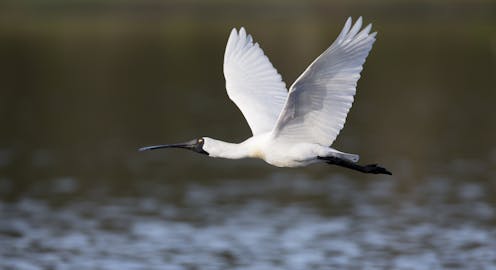
Correspondingly, many new species have naturalised on our shores. Welcome swallows, royal spoonbills, Australian coots, spur winged plovers and white-faced herons started making their home here during the 1930s to 50s.
Silvereyes have been here longer, first reported during the 1850s, while glossy ibis and barn owl only started breeding here this century. All likely flew across the Tasman to settle here.
Some arrivals seem to serve as ecological replacements of a kind. The kāhu (swamp harrier) is a stand-in for the now-extinct Eyles’ harrier and Haast’s eagle. The poaka (pied stilt) is a common sight where kakī once dominated. And Australian coots proliferate where New Zealand coots once waded.
Native habitats for native birds
These birds are following ancient patterns and processes. Where new opportunities appear, new organisms will rise to fill them. Our highly modified ecosystems are responding in the only way open to them, with exotic species expanding their range to take advantage of empty ecological niches – job vacancies in the ecosystem.
Indeed, these invasions are likely to become more frequent as species distributions shift in a warming climate. As our native species decline under threats of habitat loss and predation by mammalian pests, they will be ecologically replaced by other species.
Left to their own devices, Aotearoa’s plants and animals will look different in the future. The unique species that have called these islands home for millions of years will increasingly be replaced by more generalist species from elsewhere.
The good news is that in predator-free native bush, endemic birds can outcompete introduced species.
The route to protecting our native species in a fast changing world remains as clear as ever – protect and restore native habitat and eradicate mammalian predators.
Authors: Pascale Lubbe, Postdoctoral Research Fellow in Molecular Ecology, University of Otago


 Hashtag.net.au
