

a perennial favourite and a summer stunner
- Written by Gregory Moore, Senior Research Associate, School of Agriculture, Food and Ecosystem Sciences, The University of Melbourne
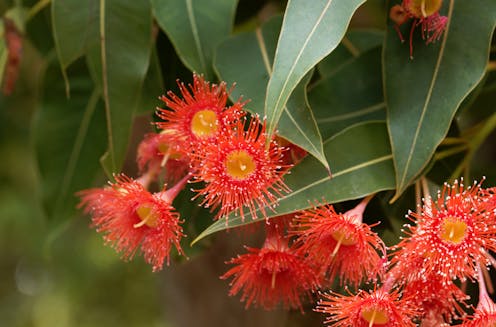
If you’ve been on a summertime stroll in recent weeks, chances are you’ve seen a red flowering gum, Corymbia ficifolia.
This species comes from a small area of south west Western Australia but has been a perennial favourite with Australian gardeners for well over a century. It’s often planted in domestic gardens, streets and parks, demonstrating its versatility and appeal.
But while its large brilliant flowers attracted early horticultural attention, this summertime stunner’s path to being a successful urban tree has not always been easy.
Difficult to grow from cuttings
Red flowering gum is a small-to-medium-sized tree that can reach a height of about 15 metres, but most trees are ten metres or less.
Its leaves are somewhat fig-like, as the name, ficifolia, suggests. They are shorter, wider and a deeper green than many eucalypt leaves.
While it can be frost sensitive when young, it usually copes well once it reaches a height of two or three metres.
Red flowering gum can tolerate a wide range of different soil types and its often massive lignotuber means it can cope well with the occasional fire. (A lignotuber is a swelling at the base of the trunk containing dormant buds and carbohydrate).

Corymbia ficifolia can produce flowers that are white, pink, orange or red, but red is the favourite.
In fact, a great deal of effort over many decades has gone into getting commercial specimens that reliably produce the expected colour.
This might be easily achieved in other plant species. Eucalypts, however, are notoriously difficult (but not impossible) to grow from cuttings and to graft.
Most red flowering gums have been grown from seedlings, where there is always the risk of variability in characteristics, including colour. Cuttings are clones and so are the same colour as the single parent tree. Seedlings, on the other hand, share genetic material from two parents, which leads to variability in colour.
Much of what we know about eucalypts has comes from forestry, where there has been huge commercial interest and funding for research.
However, the great potential of Corymbia ficifolia as a popular nursery product has ensured continuing horticultural interest, effort and expenditure for decades.
Horticultural history
All sorts of experiments have been done in an attempt to propagate cuttings of red flowering gum, and they represent milestones in our knowledge and research about eucalypts.
In the very early days, back in the late 1800s, classic selection techniques were used to source seed from the best of the red flowering gums. The idea was that while not all would produce progeny with great colour, many would have good colour because of their excellent parentage.
Nursery production in the late 1800s was in full swing, so attempts to grow Corymbia ficifolia from cuttings were inevitable, but there was little if any success.
However, by the 1950s it was known to foresters that eucalypt juvenile material was more likely to prove successful.
Some tried to grow cuttings using juvenile material from seedlings or using shoot tips from trees known to be bright red.
Others tried propagating from epicormic shoots (which spring from just under the bark) and lignotuberous shoots, which possess many juvenile characteristics.
But while there were a few successes, the rate was far too low to be commercially viable. Growing red flowering gums from seedlings continued to be the way.
By the 1970s, the using of rooting hormones was allowing greater success.
But soon tissue culture, which involved the use of complex mixtures of hormones in sophisticated growing media, emerged as a successful propagation technique.
It worked, but tissue culture of eucalypts was not easy; there was lots of expensive trial and error before success.
A lack of consistent success means this form of propagation has yet to be taken up by industry.
 Red flowering gums aren’t just popular with humans.
Neil Cox/Shutterstock
Red flowering gums aren’t just popular with humans.
Neil Cox/Shutterstock
While all this was happening, others in research laboratories and nurseries were also trying to graft selected red flowering gum shoots onto established seedling root stocks.
The previous work on cuttings and contemporary work on tissue culture provided some insight into what might be required to successfully graft red flowering gum onto other eucalypt, or even its own species’ root stock.
But it still took time and effort before real success was achieved around the turn of this century.
Grafting often results in smaller trees that flower precociously and abundantly, which is probably why they are of smaller stature. Flowering early and so abundantly takes a lot of a tree’s resources and so they often grow smaller in stature.
Hard work and good science
These days we can take the varieties of Corymbia ficifolia for granted. We might see a mini red or baby orange or a tall pale pink fairy floss, summer red, apricot dawn or the white snowflake in spectacular garden or streetscape plantings.
If you see a very small or very large brilliantly coloured flowering gum, odds are that it is one of the newer grafted varieties of Corymbia ficifolia.
If you have a grafted variety in your garden, make sure you remove shoots that might grow from below the graft. They can grow very fast and revert to the original red flowering gum form and colour.
I still have a real soft spot for the spectacular larger red flowering gums. Perhaps it is due to a childhood memories, or a reminder of when students and I were attempting (with mixed success) to grow red flowering gum cuttings using various plant hormone combinations in the mid 1980s.
Or perhaps it’s because we are still yet to crack all the secrets involved in producing great specimens every time.
But most likely it is because I know how much hard work and good science has gone into giving us the splendid Corymbia ficifolia specimens we see today.
Authors: Gregory Moore, Senior Research Associate, School of Agriculture, Food and Ecosystem Sciences, The University of Melbourne
Read more https://theconversation.com/the-red-flowering-gum-a-perennial-favourite-and-a-summer-stunner-246485


 Hashtag.net.au
