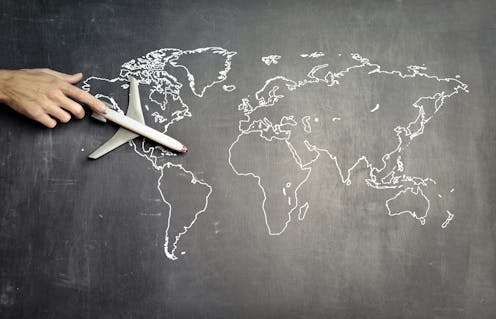
Just before the May budget, the federal government made a surprise announcement: it will introduce caps on the number of international students in the country.
It is fair to say this plan is really worrying some Australian universities.
The sector argues cutting student numbers will see job losses and less money to do research. They also warn cuts will hurt their international reputation and place in global rankings.
This is because international education is a vital source of funding for Australia’s universities. Universities collected about A$8.6 billion from international students in 2022 – more than a quarter of all revenue.
Given the sums involved, the introduction of caps has the potential to have the most significant impact on Australia’s tertiary education system in decades. But a major unanswered question is what the caps will be and how they will be calculated.
Remind me, what did the government announce?
Education Minister Jason Clare introduced legislation to parliament on student caps almost immediately after the budget was released. This would provide ministerial powers to regulate international education in Australia by:
pausing the registration of new providers and new courses
limiting the enrolments of overseas students by provider, course or location, over a year
automatically suspending and cancelling courses.
This comes as the government seeks to reduce net overseas migration (the increase in the number of people in Australia) to pre-pandemic levels of about 260,000 people per year.
It also follows similar moves in Canada and the United Kingdom, which have introduced changes to limit the number of international students in their countries.

Who is affected by this change?
So far, the focus of the impact on international student caps has been on universities. But there could be much wider impacts in the economy and community if international student numbers are capped.
One thing that is often lost in the debate is the diversity of the international education sector. Universities only make up about 40% of current international student enrolments.
The remainder of students are in private colleges, English language schools and secondary schools.
International students are also important parts of Australia’s workforce. The occupation with the largest number of international students is “carer and aides”. This means industries like aged care and disability support rely on an international student workforce.
In 2023, international education was also Australia’s fourth largest export valued at $48 billion. Of this, $17 billion was collected in course fees and the remaining $31 billion was spent in the broader economy.
This means any change to international student numbers could have an impact way beyond the campuses of Australia’s elite universities.
We still need detail
During his budget speech, Treasurer Jim Chalmers focused on housing as a central to how caps will be calculated.
As he told parliament:
[…] for too long, enrolments have grown without being matched by an increase in student housing supply.
We will limit how many international students can be enrolled by each university based on a formula, including how much housing they build.
But it is not yet clear how this will happen.
It is also unclear how much international students are impacting upon housing costs. Some research has shown the impact of international students on housing and rental prices is small.
One factor the government could consider here is how many domestic students are enrolled at a particular institution. This is so domestic students do not suffer from a cut that sees fewer resources where they study.
In Australia, it is certainly true the larger, more prestigious universities have the most international students. But they also enrol huge numbers of domestic students.
The largest private vocational colleges enrol almost exclusively international students, usually in courses like business and hospitality. As our analysis (below) shows, of the ten largest private providers, nine were private colleges where there were few domestic students.
It is important to note, this is the part of the international education sector identified as having the most problems with compliance and exploitation. This is what the government has been keen to crack down on when it talks about “shonky” providers.
What happens now?
The bill has been referred to the Senate’s education committee, which is due to report on August 15.
In many ways “too many students” is a good problem to have. It demonstrates Australia’s international education sector is strong.
But we have to watch out for unintended consequences. The diversity of the system – from elite, research universities educating both international and domestic students to private colleges largely educating international students – also needs to be taken into account.
And to adequately understand the impacts, we need more detail now from the government about how they plan to do it.
Authors: Peter Hurley, Director, Mitchell Institute, Victoria UniversityRead more



 Hashtag.net.au
