

here’s why eucalypts are survival experts
- Written by Gregory Moore, Senior Research Associate, School of Ecosystem and Forest Sciences, The University of Melbourne
They can recover from fire. Grow back from a bare stump. Shrug aside bark loss that would kill a lesser tree. Endure drought and floods.
Eucalypts are not interested in dying. They’re survivors. The world’s 800-plus species are almost all found in Australia, a continent with old, degraded soils and frequent fires and droughts.
In the fossil record, they first appear about 34 million years ago. As the Australian continent dried out, eucalypts gradually emerged as the dominant trees in all but the most arid and tropical areas.
But what is it about eucalypts that makes them survivors? It’s a combination. Leathery leaves. Fire-resistant bark. Dormant buds under bark, waiting for fire. Mallee roots (lignotubers) at ground level to let them regrow. Roots which put out special chemicals to unlock scarce nutrients. And gumnuts which use fire to germinate and get a head-start on any rivals.
In a difficult place to survive, they thrive. Here’s how they do it.
Read more: New research reveals how forests reduce their own bushfire risk, if they're left alone
Leaves
Many gum species have leaves which hang vertically. These adaptations are about water. Water in Australia is often scarce, and it makes sense for trees to hold onto it when they have it. Vertical leaves means less direct sun, which means less evaporation. Their dry, leathery leaves also keep the water inside. It also improves their tolerance to bushfire.
Bark
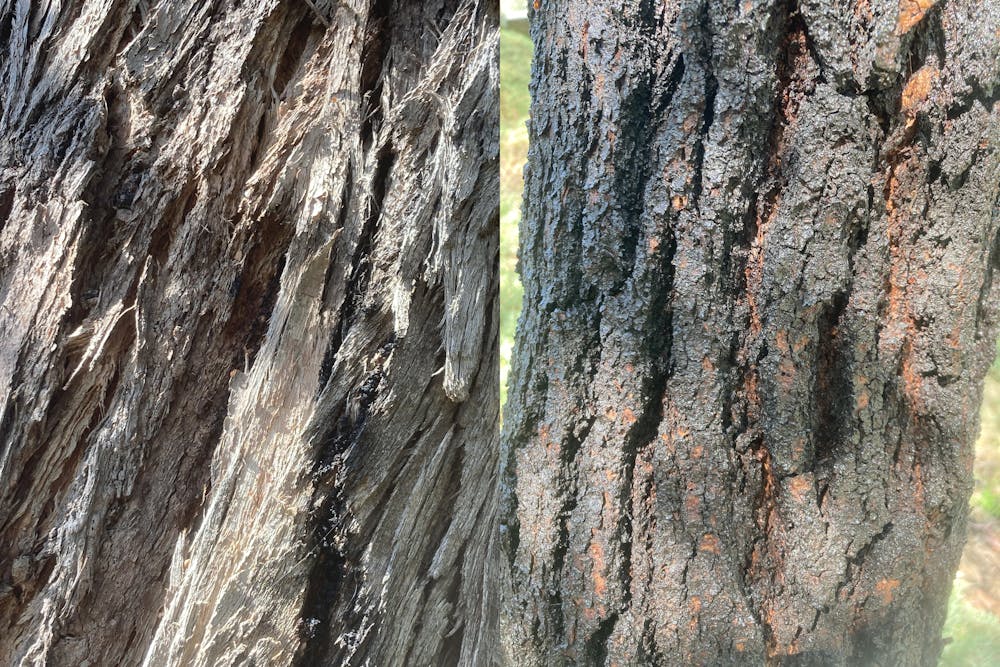
Stringybark, ironbark, candlebark – the bark of eucalypts is used to identify them. But it’s also one of their great adaptations. The bark is often an excellent insulator against hot, dry summers as well as a protective barrier against fire.
Stringy bark is so fibrous that despite singeing and looking black on the surface, it often doesn’t burn, meaning buds beneath it are protected from damage.
Buds
Underneath the bark of a normal-looking eucalypt lie thousands of dormant buds. These invisible “epicormic” buds are a remarkable adaptation, letting the tree rapidly regrow after bushfires, severe insect and animal grazing, storms, droughts or floods.
You can spot epicormic shoots sprouting up and down the trunks of gum trees after a fire, making them look like “toothbrush trees”.
Epicormic shoots can grow 27cm in a single day, or up to 6 metres in a year. When epicormic buds touch soil, they can sometimes develop as roots. This allows fallen trees or even large branches to re-establish and anchor after storms and floods.
You can sometimes see hundreds of woody spines on the trunks of old dead trees. These are a pointy reminder of how many undeveloped epicormic buds lurk under the bark.
Mallee roots (lignotubers)
As remarkable as epicormic buds are, they’re not the recovery mechanism of last resort. That job falls to the bulge at the bottom of many eucalypt trunks, which we often call “mallee roots”.
These are lignotubers, remarkable adaptations possessed by most eucalypts.
To appreciate the complexity and biological beauty of a lignotuber, imagine the trunk of a eucalypt with all its epicormic buds scrunched into a ball at the base of the trunk. The buds have direct access to a large root system able to supply water, nutrients and carbohydrates.
This is a gum tree’s emergency reboot option. Even when the tree above is falling apart, the lignotuber can rapidly regrow the tree at a rate of 6 metres or more in a year.
Roots
The roots of species such as river red gums drive deep into the soil along water courses, searching for subterranean water supplies as a backup in case the river dries up.
For other species, the solution to limited water is to send roots far and wide, often many times further than the tree’s height. In many species, the lignotuber and roots are buried under an insulating layer of soil. This acts as protection against fire.
That’s not all. Many eucalypt species produce “exudates” from their roots – chemicals which leach into the soil and free any locked-up nutrients in poor soils.
Still other exudates seep out to help feed mycorrhizal fungi in the soil. The gum trees do this as part of a wonderful symbiosis, allowing both tree and fungus to thrive. The gum gives sugar, the fungi give water and nutrients.
This underground exchange greatly improves soil quality and lets other species grow in difficult conditions.
Gumnuts
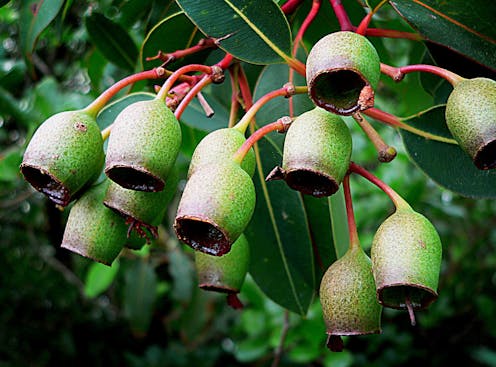
Gumnuts – woody fruits of eucalypts – are familiar to many of us from May Gibbs’ famous Snugglepot and Cuddlepie stories.
These capsules protect the tiny seeds inside from desiccation and fire. After a fire, eucalyptus fruit may be damaged or dry out. This frees the fine seeds, which sprinkle over the soil like pepper over dinner.
Some eucalypts rely not on lignotubers or epicormic buds but on the seeds contained and protected in those woody gumnuts. The seeds fall to the ground and germinate when conditions are right renewing the forest.
Survivors – but not immortal
In the years ahead, we’ll see natural disasters occurring more often and with greater ferocity as the climate changes. And in the aftermath, we will also see the spectacular and rapid responses of eucalypts – one of the world’s great families of survivors.
But we will also see dead forests. Gum trees do perish, despite their abilities to regenerate. Some species such as mountain ash are not coping with pressures such as logging and climate change, while thin-barked snow gums are struggling to cope with new fire regimes. Every living thing has limits.
Read more: Yes, the Australian bush is recovering from bushfires – but it may never be the same
Authors: Gregory Moore, Senior Research Associate, School of Ecosystem and Forest Sciences, The University of Melbourne
Read more https://theconversation.com/hard-to-kill-heres-why-eucalypts-are-survival-experts-222743


 Hashtag.net.au
