

how to help your child take risks at the park
- Written by Tonia Gray, Professor, Centre for Educational Research, Western Sydney University
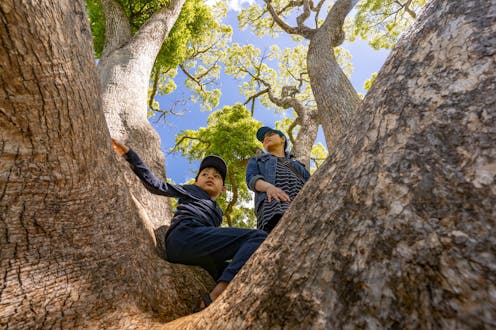
There is ongoing concern about the impact of “helicopter parenting” on children’s growth and development.
Keen to ensure the best outcomes for their children, helicopter parents tend to hover over their kids, constantly trying to prevent misadventure or harm.
But child experts say this can lead to a lack of resilience and tenacity in children. Children can also struggle with problem-solving and initiative.
How can we overcome this?
We are educators who study risky environments. Our new research looks at parent’s perceptions of an outdoor play park. It shows how outdoor parks provide opportunities for children to engage in risky play and develop independence and problem-solving skills.
The importance of risk
Risk taking means engaging in any behaviour or activity with an uncertain physical, social, emotional or financial outcome.
Risk is an everyday part of life, from driving a car to buying a house at auction or climbing a ladder.
We cannot eliminate risk, so we need to learn how to navigate it. This means taking responsibility for assessing potential consequences and taking necessary precautions. For example, crossing the road carries risk, but we learn how to look for cars or cross at traffic lights if the road is very busy.
Recognising and appropriately responding to risk taking is an integral aspect of children’s growth and development. In 1998, US educator and wilderness guide Jeff Liddle observed risk was instrumental to lifelong learning.
Outdoor experiences are particularly good places to develop skills around risk because they are not a controlled environment. For example, no two trees are the same to climb and conditions can vary depending on the weather.
Our study
In a new study we surveyed parents and caregivers about children’s risk taking in the Boongaree nature play park in Berry, New South Wales.
The park includes fixed equipment such as slides and climbing ropes as well as natural elements such as water, stone, timber, sand and greenery.
We chose Boongaree after it became the focus of media and social media debate due to a spate of injuries, including broken bones. The Daily Mail suggested it was Australia’s “most dangerous playground”. Following community concerns, the park’s tunnel slide was replaced in May this year with another slide with less “momentum”.
Over multiple visits to the park in June 2023, we recruited 302 adults to complete a survey about their children’s park use. We then followed up with a closed Facebook group of 56 parents from the same group.
The benefits of risk
We asked parents to share their views about the park and they told us risky park play had many benefits. These included allowing children to:
be challenged and solve problems
connect to the outdoors
direct their own play
be physically active
be creative and curious
demonstrate confidence and independence and
build social capacity, by sharing equipment and taking turns.
As one parent told us:
The look on children’s faces as they reach the top of climbing ropes and start walking across the bridges is fabulous – grit and determination, followed by a big deep breath […]
Another parent spoke of the importance of giving kids the opportunity to
make their own decisions about the risk they want to take, how high or how fast they will go.
Yet another parent described how the park gave children the “freedom to play in any way they feel comfortable”.
Read more: Five ways parents can help their kids take risks – and why it’s good for them
How to support your child in outdoor, risky play
So next time you go to the park, how can you support your child to take appropriate risks? Here are some tips, based on our work on children, risk and outdoor play:
Start with a positive mindset: playgrounds are designed to develop physical and social skills. So be prepared for your child to try new things at the park (rather than just play it safe with the same old equipment).
Be ready to support – and to stand back: there are times when it is best to stand back and let children experience the equipment or the area for themselves. There are others where parents are needed. So keep a monitoring eye on things. But don’t assume you will be helping all the time.
Language matters: try to steer away from language such as “be careful”. This can set children up to be afraid of a situation. Reframe your language to something more supportive, such as “is there a stronger piece of wood to put your foot on?” or “have you seen the hole over there?”
You could also say something like, “look around, do you want to explore left or right?”. This prompts your child to think about the best approach for them and builds self confidence and problem-solving skills.
Give useful advice: help children with specific guidance on how to use equipment safely. For example, when climbing you could say, “use three points of contact, two hands and one foot on that ladder”.
Let the child decide: allow your child to decide what pieces of equipment they use and how far they climb. Do not push them to complete activities they are not comfortable with. And by the same token, intervene only when the equipment is clearly above their skill development level.
Have fun: show excitement, join in the imaginative games and reinforce the message that it is acceptable to say no or yes to challenge – both choices are OK!
The authors wish to acknowledge Amanda Lloyd, who contributed to the research on which this article is based.
Authors: Tonia Gray, Professor, Centre for Educational Research, Western Sydney University


 Hashtag.net.au
