

Sydney Theatre Company's Julia powerfully imagines the life and emotions of the woman behind the 'misogyny speech'
- Written by Camilla Nelson, Associate Professor in Media, University of Notre Dame Australia
Just over 10 years ago, then-Prime Minister Julia Gillard stood up in the House of Representatives to deliver one of the most unforgettable political speeches in recent memory.
Office workers shared it at the water cooler and over coffee cups. Mothers shared it with their daughters. The speech went viral on the internet. And was watched by women around the world.
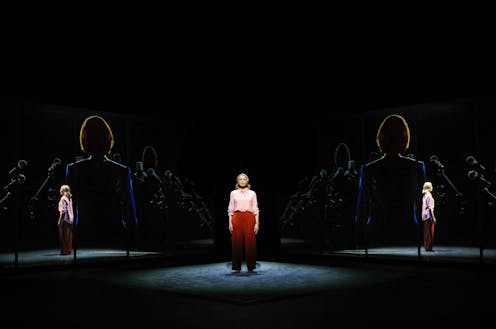
Gillard’s “misogyny speech” forms the inciting incident and climatic ending of Joanna Murray-Smith’s new play Julia, produced by the Sydney Theatre Company, featuring actors Justine Clarke and Jessica Bentley.
Only this time – on opening night at the Sydney Opera House – Gillard’s words arrived in a changed world, receiving a standing ovation that was equally for Clarke’s 90-minute virtuoso performance and Murray-Smith’s impassioned writing.
This play is not just about the extraordinarily toxic sexism that Gillard endured, but how she endured it.
Murray-Smith powerfully imagines the felt life, memories and emotions of the woman behind the words, in a work that is avowedly fictional even if built from the facts of Gillard’s life.
‘I will not be lectured about sexism and misogyny by this man’
The opening lines of the play set the scene: Canberra, October 9, 2012. Gillard, as prime minister, is squaring off with the leader of the opposition, Tony Abbott, in the House of Representatives, across the dispatch box.
The first three words of the speech – “I will not” – welling up, from deep inside, send her hurtling back through time and memory. She finds herself in a childhood conversation with her mother, whose lilting Welsh accent is seamlessly reproduced by Clarke, as is the voice of a primary-school-aged Gillard, who insists “I will not” have children: there are better things to do.
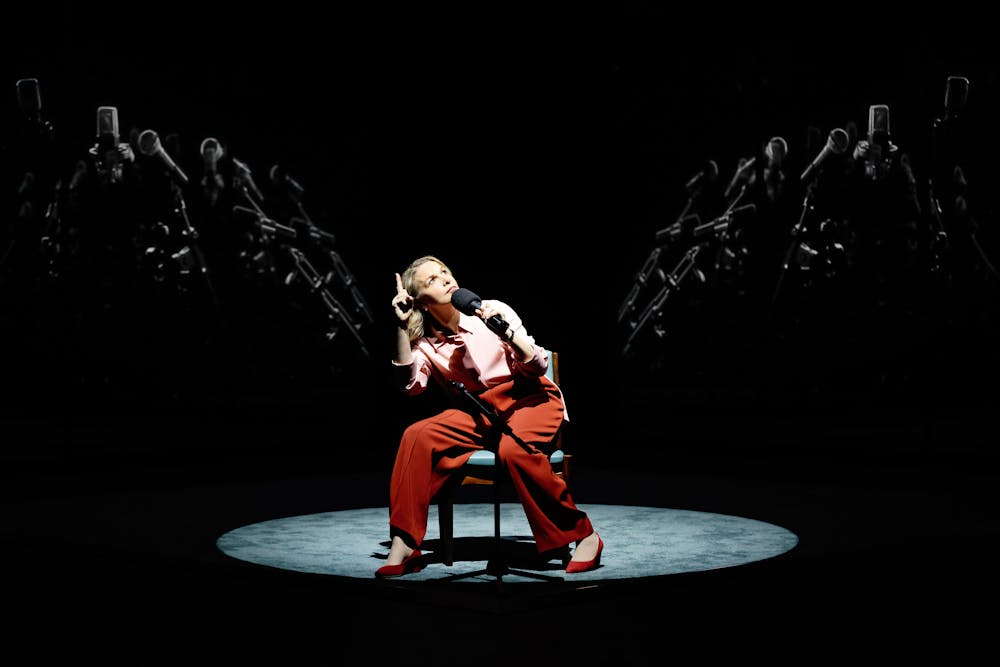
Clarke proves herself an actor of extraordinary range in what is essentially a one-woman play, with Bentley playing a silent part, as a younger woman, looking on.
Clarke segues from Gillard as a child to a young woman caught up in the “big hair” and dance moves of the 1980s, a successful corporate lawyer and then prime minster. Astonishingly Clarke twists her face into a deeply familiar, lopsided smirk, and there is Tony Abbott, to whom she says:
“I will not be lectured about sexism and misogyny by this man. I will not. And the government will not be lectured about sexism and misogyny by this man. Not now, not ever.”
Read more: Julia Gillard hits back at a long history of sexism in parliament
Entrenched prejudice against women
Gillard’s speech erupted onto a political stage when misogyny – redefined by the Macquarie Dictionary, in the wake of her speech, as “entrenched prejudice against women” – was so omnipresent, so normal, so expected that it was invisible to many.
It was five years before #MeToo, six years before Liberal MP Julia Banks quit her seat in the House of Representatives, alleging sexual harassment, including actual groping. It was nine years before Brittany Higgins reported her alleged sexual assault to federal police, and ten years before the sex discrimination commissioner reported on the systemic and entrenched sexism that paralyses the Australian political system.
It was also ten years before a “teal wave” of female independents swept to power, eviscerating the male-dominated Liberal Party in its metropolitan base.
It was a time when the Australian media was happy to amplify sexist insults about Gillard’s clothes, hair, makeup and the shape of her hips. Even the allegedly progressive Age equated her life achievements to a fruit bowl, minus “the bananas”.
In a much-repeated statement, a Liberal MP described her as “deliberately barren”. And Abbott happily posed for television cameras before a clutch of waving placards saying, “Ditch the Witch” and “Bob Brown’s Bitch”.
Not unexpectedly, when Gillard delivered her speech, most of the Canberra press gallery – with a front row seat – entirely missed the point.
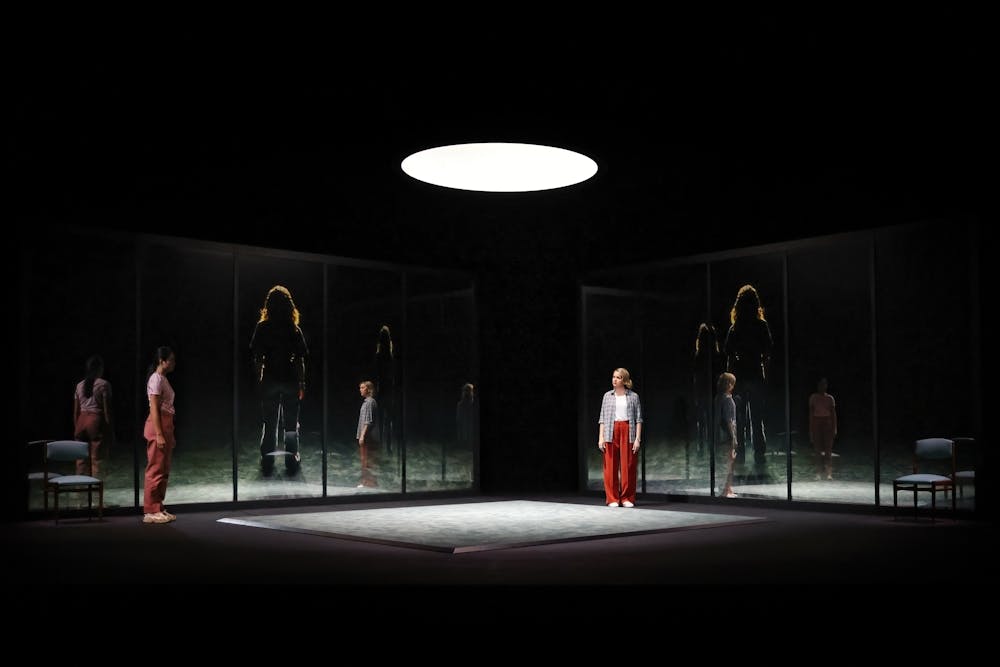 Justine Clarke and Jessica Bentley in Julia.
Sydney Theatre Company/ Prudence Upton, Author provided
Justine Clarke and Jessica Bentley in Julia.
Sydney Theatre Company/ Prudence Upton, Author provided
Courage without power
Gillard, with only a slender grip on power, mostly as leader of a minority government, passed a phenomenal 543 individual pieces of legislation in 1,098 days, making her the nation’s most productive prime minister, if the passage of legislation is understood as a government’s measure of effectiveness.
And it’s Gillard’s extraordinary capacity as a negotiator, underpinned by her deep pragmatism, that provides Murray-Smith’s most piercing insights.
It also supplies the play’s most memorable lines. “Courage” without “power” is “just a figment”, she tells us, explaining how her heart flutters in those moments when political pragmatism lifts up on “wings of idealism”. It’s a portrait of politics and policymaking as the art of the possible, driven by a concern for what or how much can be achieved – not necessarily what one thinks, wants or most desires.
The ideas gain power from the way in which Murray-Smith contrasts Gillard’s controlled workday exterior with the her night-time flights of fancy – dreaming that radio shock jocks and puerile Young Liberals will cast aside their toxic vitriol.
The play is concerned with Gillard’s reservoirs of emotional strength but does not shy away from where she failed, or what she got wrong. This includes a failure to act on refugees, gay marriage and the extension of punitive Howard-era “welfare to work measures” to single-parent families (which ironically passed through the Senate on the day of the “misogyny speech”).
It also shows a clear awareness of what was lost. And what should have been done but wasn’t.
Perhaps, at the end of the play, what lingers is not the anger and passion and rage, but the sense of hope and the fragile optimism. An idea that we can be better, do better.
It was, I suspect, hope that brought the opening night audience to its feet.
Authors: Camilla Nelson, Associate Professor in Media, University of Notre Dame Australia


 Hashtag.net.au
