

Hashtag
The Times

Albanese government tackles housing crisis on 3 fronts, but there's still more to do

  • Written by Hal Pawson, Professor of Housing Research and Policy, and Associate Director, City Futures Research Centre, UNSW Sydney
Albanese government tackles housing crisis on 3 fronts, but there's still more to do

The Albanese government’s housing package moved a step closer to delivery with the recent release of draft legislation. The bills are expected to be tabled in parliament soon. After a decade of general federal disengagement from housing policy (first home ownership being the main exception), this is more than welcome.

At the same time, the proposed laws don’t give enough priority to the need for a coherent approach to a complex housing system. Multi-faceted problems such as homelessness, unaffordable rents, mortgage stress and a lack of social housing demand joined-up solutions. Housing knowledge and policy-making capacity within government have been badly eroded and must be restored.

The draft legislative package comprised three bills (and a helpful explanatory memorandum):

  • National Housing Supply and Affordability Council Bill

  • Housing Australia Future Fund Bill

  • Treasury Laws Amendment (Housing Measures) Bill.

Beyond this, the National Housing and Homelessness Plan now being developed by the government should provide the vital strategic framework that has been so glaringly absent. This means it could be even more important than the measures in the draft bills. Arguably, the plan should also be enshrined in law.

Read more: Homeless numbers have jumped since COVID housing efforts ended – and the problem is spreading beyond the big cities

What’s good about the package?

In our submission on the draft package, we commend the progress towards reasserting Commonwealth leadership on housing. State and territory commitments and actions are vital, too, in confronting Australia’s mounting and complex housing challenges. But federal engagement and ambition are essential to make any significant and lasting progress.

The National Housing Supply and Affordability Council promises to restore the foundation for evidence-based policy once provided by the former National Housing Supply Council.

Similarly, after more than ten years of negligible investment in new social and affordable housing, the $10 billion Housing Australia Future Fund is certainly a laudable commitment. However, the aim of building 30,000 new social and affordable housing units over five years is relatively modest. We estimate current unmet need for social housing equates to 437,000 households.

The recent National Housing Accord on expanded construction output could also play a meaningful role. Full details are yet to be released.

Vertical bar chart showing state-by-state changes in social housing stock and population
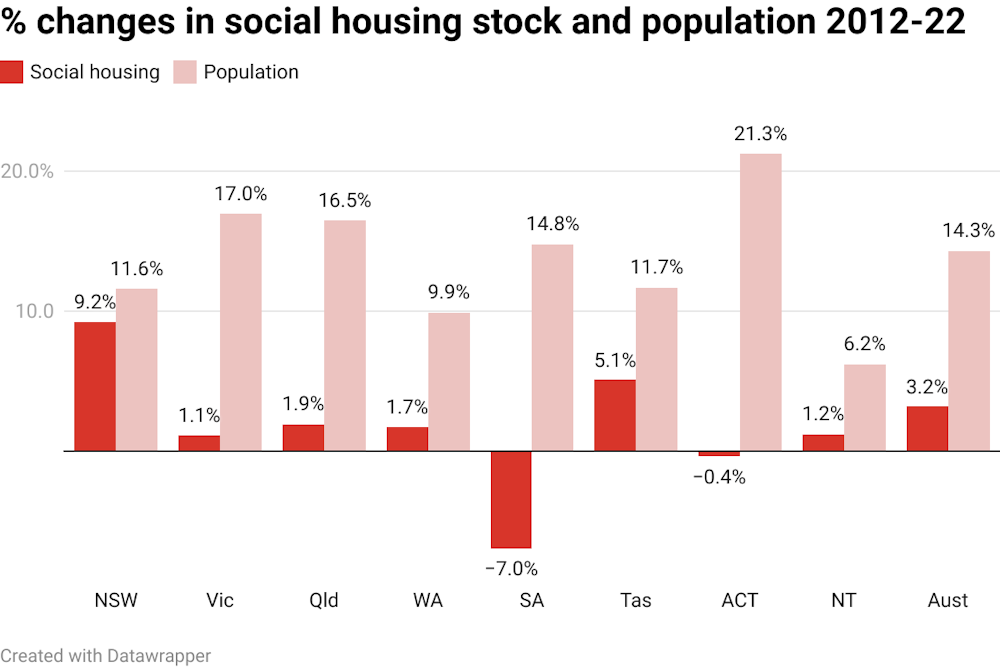
Chart: The Conversation. Data: Author provided from Productivity Commission Reports on Government Services, Australian Bureau of Statistics, CC BY Read more: 1 million homes target makes headlines, but can't mask modest ambition of budget's housing plans And what will it take to fix the housing system? As argued in our book, the declining performance of Australia’s housing system is not just a matter of historically miserly government funding. It’s also a result of policymaking failure. That failure reflects the long-term deterioration and fragmentation of governmental capacity in this realm. At both federal and state levels, the past 25 years have seen the progressive disappearance or downgrading of ministerial housing portfolios and associated departments. At the same time, housing policy has been increasingly viewed as a narrowly defined subset of welfare policy. These changes have eroded housing policy knowledge and policymaking capacity within government. They’re an aspect of the hollowing out of government across many policy fields in Australia and overseas. Arguably, it has had particularly far-reaching impacts on housing in Australia. Partly for these reasons, the proposed upgrading of the National Housing Finance and Investment Corporation to a national housing agency, Housing Australia, is another commendable aspect of the legislation. What more should the government do? Potentially more of a game-changer than the measures in the draft bills is the promised National Housing and Homelessness Plan. Since housing is a complex and interactive system, micro-measures targeting selected aspects of that system are liable to have minimal or even counter-productive impacts. Housing therefore demands strategic policymaking (rather than an incremental or reactive approach). This is why Australia should emulate the Canadian government by enshrining the National Housing and Homelessness Plan in law. Doing so would reduce the risk of a future administration emasculating or abandoning the structure. As for the three draft bills, a crucial enhancement would be to strengthen the status, capacity and responsibilities of Housing Australia. Here we again take inspiration from across the north Pacific. The Canada Mortgage and Housing Corporation (CMHC) has played a crucial strategic role as a national housing agency over decades. The UK’s Scottish Homes (1989-2001) and Housing Corporation (1964-2008) were similarly influential in informing, co-ordinating and delivering housing policy. Importantly, they also championed housing within government. Read more: The market has failed to give Australians affordable housing, so don't expect it to solve the crisis With these examples in mind, there is a strong case for Housing Australia to be: given a wider analytical and research role to inform policymaking and support the National Housing Supply and Affordability Council tasked with formulating the National Housing and Homelessness Plan and co-ordinating its implementation and review made responsible for the progress and oversight of the National Housing Accord charged with informing the re-negotiation of the National Housing and Homelessness Agreement between the Commonwealth, states and territories. In short, to boost the chances that the current housing policy impetus can be sustained, the proposed institutional reforms must be both strengthened and embedded. Authors: Hal Pawson, Professor of Housing Research and Policy, and Associate Director, City Futures Research Centre, UNSW Sydney

Read more https://theconversation.com/albanese-government-tackles-housing-crisis-on-3-fronts-but-theres-still-more-to-do-198509

Health & Wellness

What Do Clinical Teams Need from Their Surgical Supply Partners?

Hashtag.net.au - avatar Hashtag.net.au

In clinical settings, surgical supply partners aren’t just vendors. They sit quietly behind the scenes of operating lists, specialist consultations, treatment rooms and recovery workflows. When they...

The Growing Focus on Communication Development in Children

Hashtag.net.au - avatar Hashtag.net.au

The early developmental years of a child's life represent a critical window for neurological growth, behavioural shaping, and language acquisition. During this formative phase, the ability to interpre...

Looking for a Family Dentist in Sydney? Here's What To Consider

Hashtag.net.au - avatar Hashtag.net.au

Finding the right family dentist in Sydney is one of the most important health decisions you can make for your household. With hundreds of practices spread across the city — from Beecroft to Bondi, Pa...

hacklink hack forum hacklink film izle hacklink grandpashabetgrandpashabet电子书下载zlibraryDeneme bonusu veren siteler 2026Deneme bonusu veren siteler 2026Kavbetmarsbahis girişbahiscasinobetparkaresbetmarsbahisbahiscasinoultrabetgrandpashabetmeritbetbetasus girişesim usajojobetcasibomholiganbetcasibommeritkingjojobetcasibomjojobetcratosroyalbetdeneme bonusugrandpashabet