

It’s hot, and your local river looks enticing. But is too germy for swimming?
- Written by Ian A Wright, Associate Professor in Environmental Science, Western Sydney University
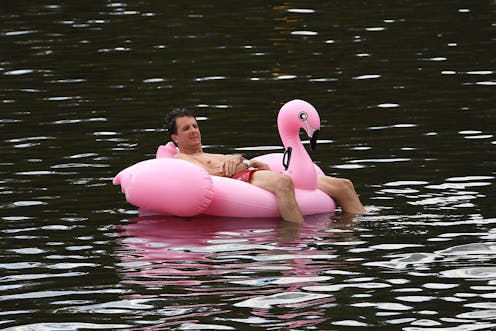
Swimming in rivers, creeks and lakes can be a fun way to cool off in summer. But contamination in natural waterways can pose a risk to human health.
Waterborne pathogens can cause acute gastrointestinal illnesses such as diarrhea and vomiting. Other common illnesses include skin rashes, respiratory problems, and eye and ear infections.
Unfortunately, it can be hard to find out if a waterway in Australia is safe for recreation. By contrast, a comprehensive system in Aotearoa-New Zealand, called Can I Swim Here?, provides timely water quality information for 800 beach, river and lake sites.
We have investigated the benefits and barriers associated with opening up waterways for recreation. Unsurprisingly, ensuring a local swimming site is safe is key to getting people using it. That includes giving people access to accurate information about water quality.
Can swimming really make you sick?
Contaminated water can exist in swimming pools and spas, as well as oceans, lakes, and rivers, exposing humans to a range of pathogens.
According to official advice in New South Wales, common waterborne pathogens include:
enteric bacteria such as Escherichia coli (E.coli) or Enterococci, that live in the intestinal tracts of all warm-blooded animals and can enter water as faecal matter (or poo). They can cause gastroenteritis, skin and ear infections and dysentery
viruses such as noroviruses and hepatitis. They can cause diarrhoea, vomiting, hepatitis and respiratory disease
protozoa such as giardia which, once ingested, can live as parasites in humans and animals and cause diarrhoea.
Australian research has documented a link between gastroeneritis and people swimming in public pools and freshwater sites such as rivers, lakes and dams.
Other water quality hazards for swimming include toxic blue-green algae and exposure to chemical pollutants.
Recent floods in Australia have led to an elevated risk of water contamination. As others have noted, flood waters can be highly polluted with disease-causing organisms, including from sewerage overflows.
So how do swimming locations get contaminated? Pollution can come from untreated sewage, or runoff containing animal poo or fertilisers. The source could be chemicals from nearby industrial activities, or the water users themselves.
Thankfully, most disease outbreaks from swimming are not fatal. An exception is the amoeba Naegleria fowleri. It lives in warmer waters and can cause amoebic meningitis, a potentially fatal brain disease.
How safe is your local swimming hole?
In Australia, guidance on recreational water quality tends to focus on ocean beaches. For example, NSW’s Beachwatch program cover more than 200 NSW coastal (and some estuary) beaches. The advice is based on likelihood of rain combined with testing swimming sites for faecal bacteria.
The Victorian government also provides coastal swimming guidance for 36 beaches in Port Phillip Bay.
But away from the coast, information on the water quality of our local rivers, creeks and lakes, is sparse.
In NSW, advice exists for swimming and boating at four sites on the Nepean River in Western Sydney. Information is provided for a recently reopened swimming site at Lake Parramatta and for swimming at some Blue Mountains sites.
In Victoria, the Yarra Watch program monitors four swimming sites in freshwater stretches of the Yarra River, upstream of Melbourne.
And authorities in Canberra provide regular water quality monitoring and swimming advice for lakes and rivers.
But in contrast to Australia, New Zealand provides far more detailed and broad guidance.
How New Zealand does it
New Zealand’s world-leading national program Can I swim here? enables people to find the best places to swim across 800 beach, river and lake sites across the country.
The advice is provided by LAWA (Land, Air, Water Aotearoa), a collaboration between regional councils, the New Zealand government, scientific experts and academics, and a philanthropist organisation.
The data available includes both the latest weekly water quality test results, and results dating back five years.
The guidance also includes an interactive map (see below) where users can zoom to swimming sites in their region.
More work is needed
Everyone loves to be around, on and in the water, especially during summer. As well as providing a way to cool down, local swimming holes are great places for people to socialise, exercise and engage with nature – especially for those not near a beach.
Governments are recognising the real opportunity to open up underused waterways for recreation across Australia. But for the sake of our communities, more work is needed on improving water quality and sharing information.
Australia has a lot to learn from New Zealand and other countries on how to manage our waterways for recreational use. And ongoing research, partnering with government and industry, is clearly needed.
Read more: Travelling around Australia this summer? Here's how to know if the water is safe to drink
Authors: Ian A Wright, Associate Professor in Environmental Science, Western Sydney University


 Hashtag.net.au
