

how moving from land to water led to the surprisingly touchy courtship of sea snakes
- Written by Jenna Crowe-Riddell, Postdoctoral research fellow, University of Michigan
Although sea snakes aren’t usually associated with intimate interactions, our new research is revealing their “sensitive” side.
In a study published today in the Biological Journal of the Linnaean Society, my colleagues and I detail the enlarged touch receptors which evolved in the male turtle-headed sea snake (Emydocephalus annulatus).
We suspect these curious sensory organs help the males keep up with their female counterparts underwater.
As I headed to sea
The sun rises over the calm water of Baies des Citrons in Nouméa, New Caledonia. I don my wetsuit and snorkel out in search of turtle-headed sea snakes.
Once I slip into the water it doesn’t take long to spot one; a yellow and black banded male swims with purpose along the rocky reef. It’s the winter breeding season.
A banded male turtle-headed sea snake swims along the reef, looking for females.During mating season, a male will search frantically for females and approach nearly everything that moves, including my flippers!
When he does find a female, he begins a curious courtship behaviour — undulating his body over hers, while repeatedly prodding his head into her back.
The female swims to the surface to breathe as the smaller-bodied male rushes to keep up. As she dives back down, he becomes disorientated and swims in the opposite direction. Realising he has lost her, the male erratically circles their last place of contact. She may be metres away, but he’ll probably never find her again.
This is a common story for this species. One study found up to 60% of males will lose contact with females they encounter.
Sea sense: how do sea snakes find their mates?
On land, snakes use tongue-flicking to sense and follow sex pheromones left by other snakes. In the water, however, these chemicals are diluted.
Turtle-headed sea snakes also can’t see very clearly underwater and have been known to court anything long and dark, including sea cucumbers. To make matters worse, once a female is found, the male must overcome buoyancy force so he doesn’t float away from his potential mate.
Given the challenges of living underwater, my colleagues and I hypothesised male turtle-headed sea snakes might have an enhanced sense of touch, to maintain contact with females during close courtship.
Underwater tactile foreplay
Most snakes have a dusting of thousands of touch receptors that look like freckles all over their face. These touch receptors are much larger in sea snakes, potentially so they can sense vibrations made by swimming prey and predators.
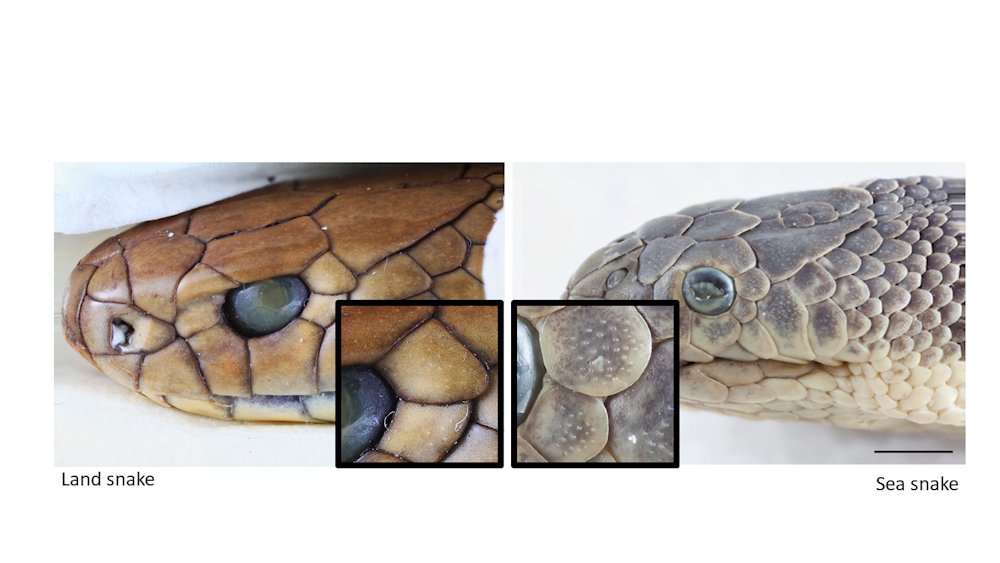 A comparison of scale receptors in a land snake (Pseudonaja textilis) and sea snake (Hydrophis schistosus).
xx, Author provided
A comparison of scale receptors in a land snake (Pseudonaja textilis) and sea snake (Hydrophis schistosus).
xx, Author provided
One of the largest touch receptors on any snake is found on turtle-headed sea snakes. And when we took a closer look at museum specimens, we discovered males have larger touch receptors than females overall.
We also found mature males have enlarged scale structures on their snout, chin and their cloaca (which is an all-purpose hole used for reproduction and excretion). The positioning of these enlarged receptors over the body hints at the role they play in sea snake courtship.
The touch receptors on the chin of males (referred to as “genial knobs”) have the same specialised cells as those on the face, but the outer bump is four times larger.
Their position on the underside of the head gives sensory feedback to the male as he swims above females, helping him orient towards the direction of her swimming.
The touch receptors on his anal scales (or “anal knobs”) provide feedback to align both snakes’ cloacae, which is necessary for sex. Genital alignment may seem like a trivial task, but for tube-shaped limbless snakes, touch receptors on the cloaca are essential.
 Comparison of male and female turtle-headed sea snakes. Males have rostral spines (RS) and enlarged genial knobs (GK) and anal knobs (AK). Males also have larger scale receptors (SS). H = hemipene, which is a male reproductive organ.
Chris Jolly, Author provided
Comparison of male and female turtle-headed sea snakes. Males have rostral spines (RS) and enlarged genial knobs (GK) and anal knobs (AK). Males also have larger scale receptors (SS). H = hemipene, which is a male reproductive organ.
Chris Jolly, Author provided
Males also have a tapered scale on their snout known as the “rostral spine”. While courting the female, the male will prod the female’s back with this hardened scale.
We investigated the micro-structure of the rostral spine and found it is made of thickened layers of skin with no specialised sensory cells. As such, we think it may play a role in stimulating female interest in mating.
However, it provides relatively less feedback for the male, especially compared to the touch receptors on his chin and cloaca.
 Positioning of the scale structures on a male turtle-headed sea snake. RS = rostral spine and GK = genial knob.
Photo of full snake by Max Jackson; photos of tactile receptors by Chris Jolly, Author provided
Positioning of the scale structures on a male turtle-headed sea snake. RS = rostral spine and GK = genial knob.
Photo of full snake by Max Jackson; photos of tactile receptors by Chris Jolly, Author provided
A similar form of “tactile foreplay” has been observed in species of boas and pythons. These snakes have hard claws known as pelvic spurs near their cloaca, which are vestigial remnants of legs lost through evolution!
During courtship, males will scratch and pry at the female’s scales during mating. Such sinuous courtship can stimulate beneficial hormonal changes and receptive behaviours in females, such as “cloacal gaping” which increase mating success for both sexes.
Could the rostral spine in turtle-headed sea snakes play a similar role in stimulating females?
The mating begins.Evolutionary transitions
Sea snakes evolved from land snakes some 20 million years ago. Most live their entire lives at sea.
Decades of research have revealed their remarkable morphological adaptations to aquatic life, including paddle-shaped tails, salt-excreting glands and the ability to breathe through their skin. Now, our research is beginning to uncover the importance of touch for social behaviours in sea snakes.
While sea snakes are not typically appreciated for their sensitive side, our discovery suggests an enhanced sense of touch evolved to improve communication within members of a species. This is especially crucial in aquatic environments, where other sensory signals such as vision and pheromones are diminished.
As our work continues, sea snakes are becoming a fantastic example of how evolution can create opportunity from constraint.
Authors: Jenna Crowe-Riddell, Postdoctoral research fellow, University of Michigan


 Hashtag.net.au
