

do I really need a specific shoe for a specific sport?
- Written by Daniel Bonnano, Lecturer (Teaching and Research) and PhD Candidate, La Trobe University
Over the past 40 years the “modern” sports shoe has evolved from the all-purpose sneaker to an abundance of sport-specific shoes. Given we have so much choice – and with encouragement from big brands and keen shop assistants – it seems logical to select footwear designed specifically for each activity.
But what does the evidence say? Do we really need to wear a unique shoe for each activity we participate in?
The answer is a little less clear than you might imagine.
Read more: Children should spend more time barefoot to encourage a healthier foot structure
What you want in a shoe
Before we look at the evidence, let’s think about what we want from our sports shoes.
For me, there are three key considerations that can help guide the shoe selection process:
- the selected shoe should minimise the risk of injury in light of the sports it will be used for, and with respect to the uniqueness of the person wearing it
- our sports shoe should allow us to maximise our athletic performance, but not at the expense of increasing injury risk (let’s face it, if you get injured then your athletic performance is likely to decrease anyway!)
- our shoes should be comfortable – this may sound obvious, but some of the world’s most esteemed footwear researchers suggest that increased footwear comfort is associated with fewer injuries and improved sporting performance.
With this in mind, we need to consider the unique physical demands of each sport and what shoe features are required to help prevent injury and maximise performance.
For some sports, the benefits of using a specific shoe are quite obvious. Most would agree that football boots with built-in spriggs will help maintain traction while avoiding a tackle, while a stiff-soled cycling shoe will help power production through bike pedals during a hill climb.
However, the benefits of using a sport-specific shoe during other activities may not be as apparent. For example, is there really that much difference between netball, basketball and tennis shoes?
Court shoes versus running shoes
With the exception of basketball shoes typically having a “high-top” upper, all other features of court shoes can be quite similar – they all aim to provide support, cushioning and traction during multi-directional movements.
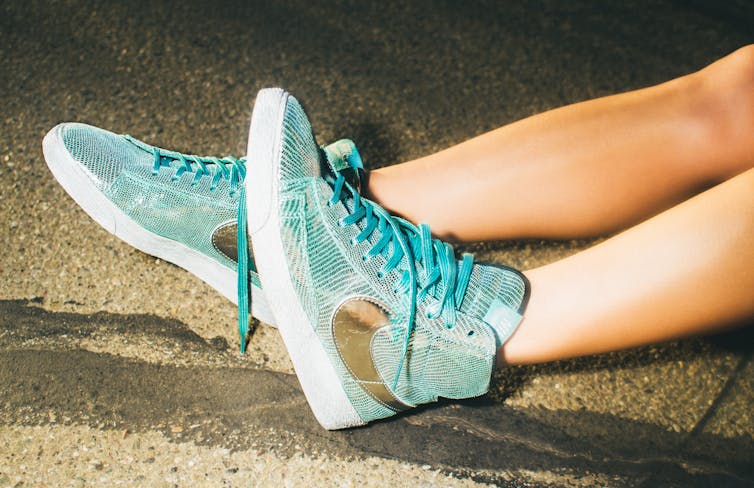 My high tops sure do look good.
Gold Chain Collective/Unsplash, CC BY
My high tops sure do look good.
Gold Chain Collective/Unsplash, CC BY
To achieve this, common features among court shoes include having a re-enforced toe, a slightly “flared” forefoot, a relatively flat sole, and being made from strong and durable materials in the uppers and outsoles (the base).
In contrast, running shoes are traditionally designed for repetitive straight line movements performed over long distances. So running shoes are generally lightweight and have a highly cushioned midsole – which is intended to dampen impact forces – while also being flexible through the forefoot to assist with propulsion.
These differences in shoe design all sound good in theory, but are they actually effective in reducing injury and maximising performance?
Unfortunately the science on this topic is scarce, but let’s look at what we know.
Read more: Sustainable shopping: how to rock white sneakers without eco-guilt
The evidence is scarce
A clinical trial found using high-top shoes for basketball does not help prevent ankle sprains – and a separate study found that high-top shoes actually decrease vertical jump height and running performance.
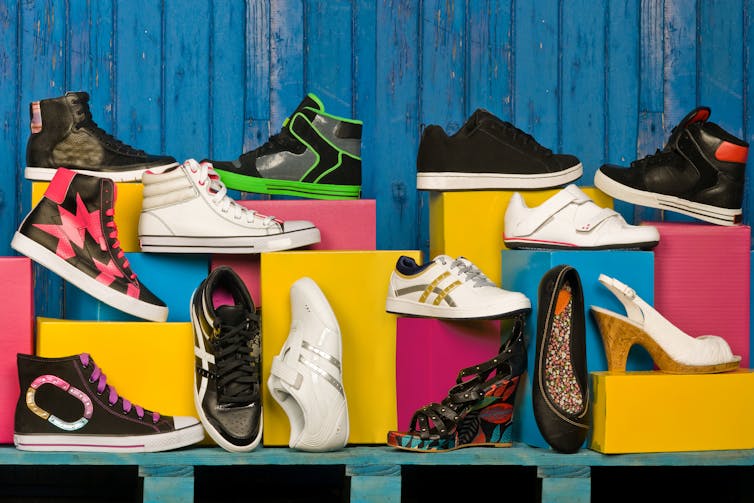 Some of these shoes may be ok for running - mostly depending on whether you find them comfortable or not.
from www.shutterstock.com
Some of these shoes may be ok for running - mostly depending on whether you find them comfortable or not.
from www.shutterstock.com
Based on these studies, I rarely recommend that people seek out a high-top shoe for court sports (but I don’t avoid them either). The priority should be on selecting a court shoe that fulfills the needs of each individual (current and past injuries must be considered) and their sport. All court shoes – irrespective of whether they are labelled a tennis, basketball or netball shoe – should be looked at. Much of this process is guided by theory and comfort given the lack of research in this area.
With respect to running, you may be surprised to learn that choice of running shoes for prevention of injury is also still largely theoretical.
Over the past decade there has been an increase in research focused on determining the features of running shoes that are most important for the prevention of injury, but none have investigated how running shoes compare to other sport-specific shoes for this purpose.
Although there is uncertainty around the benefits running shoes provide for the prevention of running injuries, we do know that running performance is improved as shoes get lighter. As running shoes are generally lighter than all other footwear options, using them will likely result in greater athletic performance compared to non-running shoes.
Read more: From tech to fetish, shoes in fairy tales are a mark of status
Can I buy all-purpose shoes?
A common question is whether a single all-purpose sports shoe is OK.
Science can’t answer this without the right evidence. But in general terms, an all-purpose shoe (i.e. something branded as a “cross-trainer” in the shops) will generally be fine for someone who participates in an array of activities, particularly if being completed at low intensities.
However, if you’re playing sports at a competitive level, or doing the same activity regularly, then it makes sense to wear sport-specific shoes – although more research is needed to confirm this recommendation.
It’s also worth stating that if you have been injury free in your current sports shoe, and you’re performing at a level you are happy with, then you may already have the right shoes on your feet.
And don’t forget, make sure your shoes are comfortable!
Authors: Daniel Bonnano, Lecturer (Teaching and Research) and PhD Candidate, La Trobe University


 Hashtag.net.au
