

3 Australian poets explore sites of memory and history – with a degree of play
- Written by Craig Billingham, Lecturer, Creative Writing, UNSW Sydney
It was the French historian Pierre Nora who coined the term lieux de mémoire – “sites of memory”. He meant to suggest that places and objects can embody or contain personal and collective memories, and that such memories can also obtain in the intangible – in a scent or a colour, for instance. “Even an apparently purely material site, like an archive,” Nora wrote,
becomes a lieu de mémoire only if the imagination invests it with a symbolic aura […] Lieux de mémoire are created by a play of memory and history […] To begin with, there must be a will to remember.
This seems a reasonable starting point with the collections under review, for it seems to me that poems might arise from sites of memory, and can also be them. Each of these collections brings imagination to bear on material objects and places, on works of art, documents and archives. Each invokes a degree of play, and even contestation, between memory and history.
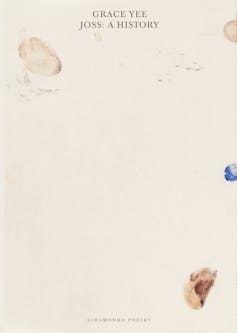
Review: Joss: A History – Grace Yee (Giramondo); Essence – Thuy On (UWA Publishing); Kangaroo Unbound – Luke Johnson (Puncher & Wattmann)
Joss: A History
Of the three, Grace Yee’s Joss: A History concerns itself most explicitly with writing back to history and the historical record, acknowledging those who have been left out, misrepresented and maligned, or excised from official accounts. The history in question is that of early Chinese settlers in Australia and New Zealand.
Yee’s method might be described as documentary or archival poetics, a method also employed by other contemporary Australian poets, Natalie Harkin most obviously.
The majority of the poems in Joss: A History incorporate verbatim or adapt lines and sentences from a range of sources (poems, newspapers, novels, etc.). As explained in the book’s notes, of which there are eight pages, three of the poems – The March, The Work, and History of Botany Bay – “are composed from extracts from The Bulletin: Anti-Chinaman Special Number. 14 Apr 1888”.
These poems emerge from a process of erasure and the results are striking. I cannot replicate the layout – the visual appearance of each erasure poem is part of its effect – but isolated words connect to become evocative phrases, such as this, from The Work:
foreignerssurrender toeverlastingwhite planet history.
And this, from History of Botany Bay:
little versesdangled from the gallowsthe plaintiff’s labourwide illustriousfree.
As well as drawing on a range of sources, Joss: A History also presents a variety of poetic forms, including many prose poems, or poems that, while lineated, may as well be prose.




 Hashtag.net.au
