

The epic novel runs amok in Omar Musa’s Fierceland
- Written by Giacomo Bianchino, Adjunct associate, University of Sydney
Omar Musa’s new book, Fierceland, ranges across five distinct geographies and covers a period of some 170 years. It is told from at least ten perspectives and encompasses prose, poetry and visual art. It is, in every way, an epic endeavour.
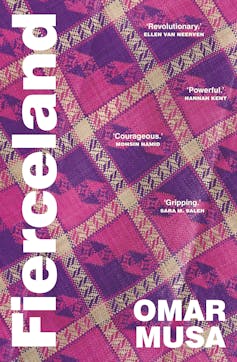
Review: Fierceland – Omar Musa (Penguin)
There has been a welcome tendency towards scale and ambition in Australian literature of the last few years. The centrepiece of this shift to grandiosity is Alexis Wright’s Praiseworthy: a book that attempts not one, but four or five separate epics in 780 pages.
This is the sort of work required by a period of polycrisis – ecological collapse, widening inequality, catastrophes of famine and genocide. It also calls for a different sort of criticism. As critic Northrop Frye said of John Milton’s epic poem Paradise Lost, Milton’s genius was not in the execution, so much as the grandiosity of his theme.
For Wright, our multiple armageddons push and break the limits of traditional literature. Praiseworthy keels and splutters, devastates individual characters’ claims to resolution, raising the suspicion that something like a unified modern story may be impossible.

Fierceland is maybe the first Australian (or Australian-adjacent) book to take up Wright’s literary challenge. Musa seems keen to position himself in the tradition of epic writers, particularly the masters of the Global South: Gabriel García Márquez, Chinua Achebe and Salman Rushdie.
The novel alludes to this in its meditation on the idea of the Hikayat – a Malay form of folk epic which tells of heroic acts. At the centre of the story is a properly epic project – a “Song of the Forest” that Musa has written and then translated into many of the unique local languages of the Malaysian regions of Sabah and Sarawak.
At the same time, Fierceland is a novel invested in the personal fortunes and psychological complexities of its characters. It tells the stories of a family’s individual fates: the father Yusuf, the mother Jenab, the aunt Nurhanizah, the uncle Hamid, the father’s henchman Jibrail, the upriver worker and guide Salam. These narratives and perspectives are focused through the children, Rozana and Harun, and framed by the apostrophes of the speaking forest.
The tension between the novelistic attention to psychology and detail and the epic tendency to breadth of scale and form makes – and unmakes – this book.
Epic perspectives
As an epic, Fierceland sings. The story mostly moves between Malaysia, Australia and America. But it also tracks back and forth across the coming-of-age of Rozana and Harun, following them from childhood to adulthood. The story creates a sense of mystery around a central trauma in their shared past and describes their attempts to reconcile themselves with it.
The fragmentation of the narrative into multiple voices also gives the novel a powerful chorality. Musa is not an amateur harmonist. He shows serious cleverness in modulating his prose style between each character. From Roz’s lapses into drug-fuelled hypotaxis to Harun’s staccato observations and uncle Hamid’s lyricism, there is a Joycean sense that each character has their own language.
Musa alludes to this idea of the fragmented, polyphonic epic when talking through his “Crazy Auntie” about the traditional Malay concept of “amok” (from the word mengamuk, meaning a frenzied attack):
There are Javanese epics where the gods can choose when and where to amok. People going amok against colonisers. Which tells me, if there’s a good reason for it, then amok is justifiable.
Through this amok of perspectives runs the story of Malaysia’s journey to modernity. With attention to regional disparities and the growth of ethno-nationalism and corruption, Fierceland uses the patriarch Yusuf to trace the ways the synthetic nation borrowed from other postcolonial success stories. Yusuf’s journey to Nigeria is a barely disguised, but ably handled, narrative of the importation of the oil palm to Asia.
These sections feel a little like Mulk Raj Anand or César Vallejo’s “supply-chain” novels of the mid-20th century, which make personal narratives of global processes.
The song of the forest
Tying together the galloping history and geography is the figure of the forest. The jungle of north Borneo speaks throughout the book in an interrupted monologue. This provides a structural anchor and serves as the supreme moral perspective. The forest operates a bit like Wright’s use of “Country” in Praiseworthy: it is the point from which every other finite story is judged and overwhelmed.
The actual forest sections, however, are problematic. On the one hand, Musa doesn’t push the idea of the forest’s speech beyond vaguely ornamental lyricism. He struggles to balance the urgency of the book’s pace with the meditative idylls of its more poetic moments.
More importantly, giving a voice to the forest settles the book’s moral questions in advance. Preserving the wilds of north Borneo becomes an imperative that outstrips all others. It is fine for an epic to have a straightforward allegorical core like this. But the forest provides little wiggle room for the moral perplexities of a novel.
Musa’s attempts to construct subtle and contradictory portraits of his characters founder on Fierceland’s ethical transparency. People in the novel are given their worth on a clear and easy spectrum, from the powerful to the exploited and marginalised.
Authors: Giacomo Bianchino, Adjunct associate, University of Sydney
Read more https://theconversation.com/the-epic-novel-runs-amok-in-omar-musas-fierceland-266790


 Hashtag.net.au
