

A new twist on Heisenberg’s uncertainty principle can sharpen quantum sensors
- Written by Tingrei Tan, Sydney Horizon Fellow and ARC Future Fellow, Quantum Control Laboratory, University of Sydney
For almost a century, Heisenberg’s uncertainty principle has stood as one of the defining ideas of quantum physics: a particle’s position and momentum cannot be known at the same time with absolute precision. The more you know about one, the less you know about the other.
In a new study published in Science Advances, our team demonstrates how to work around this restriction, not by breaking physics but by reshaping uncertainty itself.
The result is a breakthrough in the science of measurement that could power a new generation of ultra-precise quantum sensors operating at the scale of atoms.
Moving uncertainty around
The uncertainty principle makes clear there will always be a minimum amount of uncertainty in measurements. But you can think of it like air in a balloon: the air cannot escape, but you can freely move it around inside.
Similarly, when measuring position and momentum, the total amount of uncertainty is fixed. But we can redistribute it between the two.
Traditionally, this trade-off means making a choice. You can measure position precisely but lose information about momentum, or vice versa.

Our work takes a different approach. We push the uncertainty into a sensing range that is unimportant.
To understand this, let’s try another analogy: imagine a clock with only one hand. If it’s the hour hand, we know the hour exactly but only roughly know the minutes. If it’s the minute hand, we can read minutes precisely but do not know the hour.
We apply this same idea to quantum measurements. We redistribute the uncertainty so that we can simultaneously track small changes in position and momentum around a chosen point, even if we do not know the absolute location of the point itself.
With this, we can detect very tiny changes in both position and momentum at once, beyond the limit of any classical sensor.
Using error-correcting codes for quantum sensing
How did we do this? We repurposed techniques originally designed to protect quantum computers from noise to enhance the precision of measurement devices. This idea was first proposed in a theoretical study in 2017.
We performed our experiment using a trapped ion. This is a single electronically charged atom held in place and controlled with electric and magnetic fields.
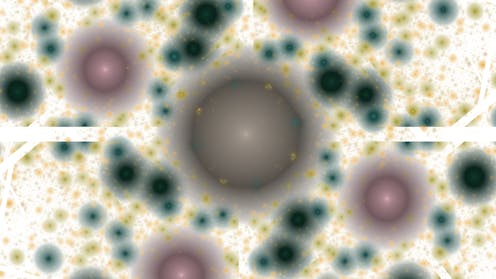
We prepared the ion in “grid states”, a kind of quantum state originally developed for error-corrected quantum computing. We then used these states as a sensor to measure tiny signals, in a way similar to how one would detect errors in a quantum computer.
This crossover between quantum computing and quantum sensing is the key idea behind our work.
Our experiment showed we can measure an uncertainty in a signal corresponding to half a nanometre, roughly about the size of an atom.
We can also measure extremely small forces, measured in yoctonewtons – that’s a trillionth of a trillionth of a newton. That’s like measuring the weight of about 30 oxygen molecules.
Why does it matter?
Being able to measure extremely small signals has profound implications. Counterintuitively, measuring the minuscule can help us improve our understanding on the grandest scale.
Quantum sensors already help gravitational-wave observatories detect cosmic events such as colliding black holes. Our work opens the door to even greater sensing capabilities, potentially deepening our understanding of astrophysical objects.
This experiment is still within the confines of a physics laboratory. It’s not a gadget you’ll see in the shops tomorrow. But we are confident this new way to make precision measurements will lead to a whole generation of ultra-sensitive quantum sensors.
Authors: Tingrei Tan, Sydney Horizon Fellow and ARC Future Fellow, Quantum Control Laboratory, University of Sydney

 Hashtag.net.au
