

In most mammals, one gene determines sex. But 100 million years ago, platypuses and echidnas went their own way
- Written by Linda Shearwin, Researcher, Comparative Genome Biology Laboratory, University of Adelaide
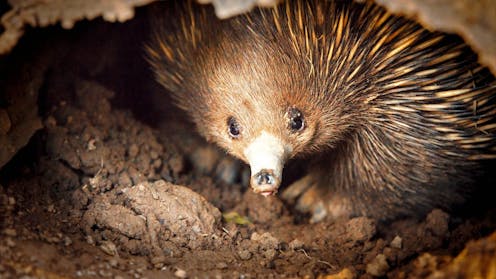
For decades, scientists have known that platypuses and echidnas – Australia’s unique egg-laying mammals – have another developmental quirk: they don’t use the same genetic toolkit as other mammals to develop male and female embryos.
What’s more, just how they do it has been a mystery. Until now.
In a recent study published in Genome Biology, our research team has found strong evidence that monotreme sex comes down to a single gene – one that’s much more like what we see in some fish and amphibians than other mammals.
The search for the secret of monotreme sex
The Australian platypus and echidna are monotremes, the most ancient living group of mammals. These unique creatures are famously the only mammals to lay eggs, and they also have other reptile-like features.
Humans and many other mammal species have two sex-determining chromosomes, X and Y. An embryo with an XX pair of chromosomes will develop as female, while an XY pair leads to a male embryo.
In many mammals, the process that makes an embryo develop as male is triggered by a gene called SRY on the male Y chromosome. However, the SRY gene in monotremes has never been found.
About 20 years ago, it was discovered that monotremes have an entirely different system that uses multiple X and Y chromosomes. Scientists assumed the Y chromosomes must still hold a gene that determined sex, but very little was known about what it might be.
In 2008 a full genome sequence of a platypus was published, which was a step in the right direction. However, the genome was from a female so it had no information about Y chromosomes.
By 2021, a new and improved platypus genome and a first echidna genome included sequences of multiple Y chromosomes. A gene emerged as the frontrunner for the role of sex determination in monotremes: the anti-Muellerian hormone (or AMH), which is involved in the sexual development in many animals.
A 100-million-year-old change
Our new research provides the first real evidence that an adapted version of AMH found on one of the monotreme Y chromosomes (dubbed AMHY) is the sex determination gene in monotremes.
We showed that changes in the AMH gene long ago, early in the evolution of monotremes, could explain how AMHY arose and took on a role in male sexual development.
This event would have set the stage for the evolution of the novel sex chromosome system in the ancestor of today’s platypus and echidna, about 100 million years ago when the AMH gene on the XY chromosomes embarked on separated paths.
We showed that although the AMHY gene has changed significantly from the original AMH gene (AMHX), it has retained its essential features. Importantly, we could show for the first time that AMHY is turned on in the right tissue and at the right time to direct development of the testes during male development, which was an important missing piece of the puzzle.
A first for mammals
Unlike the other mammal sex determination genes, which act directly on the DNA to switch on other genes that lead to male development, AMHY is a hormone. It does not interact with DNA, but instead acts at the surface of cells to turn genes on or off.
There is growing evidence that AMHY also plays a role in sex determination in a number of fish and amphibian species. However, AMHY in monotremes would be the first known example of a hormone playing a sex-determining role in mammals.
What’s next? Our ongoing research investigate in detail how AMHX and AMHY work differently in monotremes compared to other mammals.
The work discussed in this article was carried out by researchers from the University of Adelaide, the University of Melbourne, the University of Queensland, Monash University and Currumbin Wildlife Sanctuary.
Authors: Linda Shearwin, Researcher, Comparative Genome Biology Laboratory, University of Adelaide


 Hashtag.net.au
