

what your visual imagination predicts about your ability to control your thoughts
- Written by Derek Arnold, Professor, School of Psychology, The University of Queensland
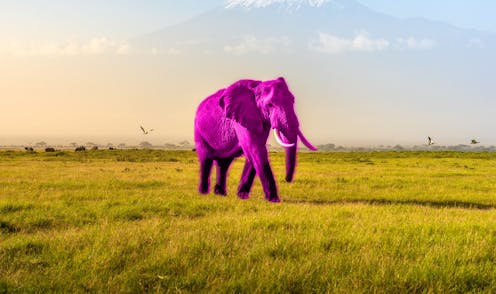
Tell a man he shouldn’t think of a pink elephant and he can’t get that beast out of his mind!
This quote, from Curt Siodmak’s 1974 novel City in the Sky, describes how hard it can be to suppress our thoughts. “Don’t think of a pink elephant” has become a classic example of how difficult it can be to intentionally avoid visualising.
Research suggests many of you, having read about a pink elephant, will have imagined seeing one.
However, some people, like us, have aphantasia – we cannot visualise. So we are a little confused at the idea other people can imagine seeing things that aren’t there.
In a new study, we have found evidence the pink elephant problem is not universal. Some people – including people with aphantasia – can block involuntary visual thoughts from their minds.
What is aphantasia?
People with aphantasia cannot voluntarily imagine seeing things in our mind’s eye. So if you ask us not to think about a pink elephant, we won’t visualise one, because we can’t.
Aphantasia is typically described as a deficit. When people first learn they have aphantasia they are often upset, as they realise other people can do things they cannot. It might be nice to imagine seeing the characters described in a book, for example, or to visualise an absent loved one.

However, deficits are often balanced by benefits. There are suggestions people with aphantasia (or aphantasics, as we’re sometimes called) may have a heightened resistance to involuntary intrusive thoughts.
Another way to look at it is that aphantasics are one portion of a natural diversity of human minds, with people having different capacities to visualise. Where aphantasics have no capacity, most people would have an average ability, and a small number of people would have an extremely strong ability to visualise.
Vivid mental imagery and involuntary visualisations
In our new study, we looked at links between the intensity of people’s visual imaginations and their tendency to visualise, even when they try not to. People with vivid visual imaginations were more likely to have involuntary visualisations, and we could predict these outcomes by measuring brain activity.
Some people might enjoy being able to imagine seeing detailed scenes whenever they wish. However, this seems to come at the cost of not being able to shut down these experiences.
Most people have less vibrant imagery, but they seem to be more able to suppress these thoughts.
Do aphantasics have peaceful minds?
Aphantasics are unlikely to have involuntary visualisations. Does that mean they have peaceful minds?
In our study people who reported having weak imagery were less likely to imagine seeing things they were trying not to think about. However, they were more likely to report mind-wandering.
If this describes aphantasics, instead of visualising things we are told not to think about, we may turn our minds to other thoughts, such as what’s for dinner. So we would not have more peaceful minds, just a resistance to think about things we are trying to put out of mind.
If aphantasics do not visualise, do they have daydreams?
From our own experience, we can confirm at least some aphantasics have minds that wander. But when our minds wander, neither of us imagines seeing things. Our experiences are different.
When Derek’s mind wanders he imagines hearing and engaging in purely audio conversations. As daydreaming is typically associated with vision, he did not realise until very recently these imagined conversations could be described as his experience of daydreaming.
Loren cannot visualise or imagine hearing things. She experiences her thoughts as different sensations of texture and imagined feelings of movement – and these are what she experiences when her mind wanders.
Are aphantasics resistant to trauma from re-living events?
Perhaps.
While our evidence suggests aphantasics are resistant to involuntary visualisations, more research will be needed to work out if we are resistant to reliving traumas, or if these will simply trigger different types of imagined experience.
What is clear is that Siodmak was wrong. If you tell people they shouldn’t think of a pink elephant, some of us will happily put that beast out of our minds, and turn our thoughts to other matters. What’s for dinner?
Authors: Derek Arnold, Professor, School of Psychology, The University of Queensland


 Hashtag.net.au
